Galaxy Ring vs Oura Ring 5: Which One Should You Actually Wear?
Quick answer: The Oura Ring 5 is the better ring — 40% smaller than the Ring 4, more sensors, the best app in the category, and new overnight blood-pressure and breathing trends. The Samsung Galaxy Ring is the better deal — no subscription ever, eleven sizes (5–15 vs Oura's 6–13), 10ATM water rating, and a street price that's been hovering around $299. Over three years the Oura costs roughly $300 more. Buy the Oura if you're on iPhone or you want the deepest sleep coaching; buy the Galaxy Ring if you're on Android and refuse to rent your own data.
Two rings, both about $400 on paper, and almost nothing else in common. One is a 2026 flagship that shrank so much reviewers stopped noticing it on their hand — and then asks you for six bucks a month, forever. The other is 2024 hardware that Samsung has quietly left alone for two years, now selling at a discount, with a bill that never arrives.
That's the actual decision. Not sensor counts, not "which app has prettier charts." It's whether you'd rather pay once and live with slightly older tech, or pay monthly and get the polished version. Here's how it breaks down after digging through both spec sheets, the launch coverage, and what long-term owners report.
Galaxy Ring vs Oura Ring 5: The Spec Sheet
| Samsung Galaxy Ring | Oura Ring 5 | |
|---|---|---|
| Price (September 2026)* | $399.99 list, widely discounted to around $299 | $399 (Silver/Black), $499 premium finishes |
| Subscription | None — ever | ~$5.99/mo or ~$69.99/yr for full features |
| Sizes | US 5–15 (eleven sizes) | US 6–13 only |
| Dimensions | ~7.0mm wide, ~2.6mm thick, concave shell | ~6.1mm wide, ~2.3mm thick (40% less volume than Ring 4) |
| Battery | Up to 7 days; charging case included | Roughly 6–9 days; charging case is a $99 accessory |
| Water rating | 10ATM + IP68 | IP68 |
| Phones | Android 11+ with Samsung Health. No iPhone. | iPhone and Android |
| Standout features | Energy Score, sleep score, double-pinch gesture (Galaxy phones), snore detection | Blood Pressure Signals, breathing trends, 50+ metrics, live workout HR |
| Last hardware update | July 2024 | May 2026 |
*Reference prices at the time of writing (September 2026); both change often — check the live listings.
What Does the Oura Ring 5 Do That the Galaxy Ring Can't?
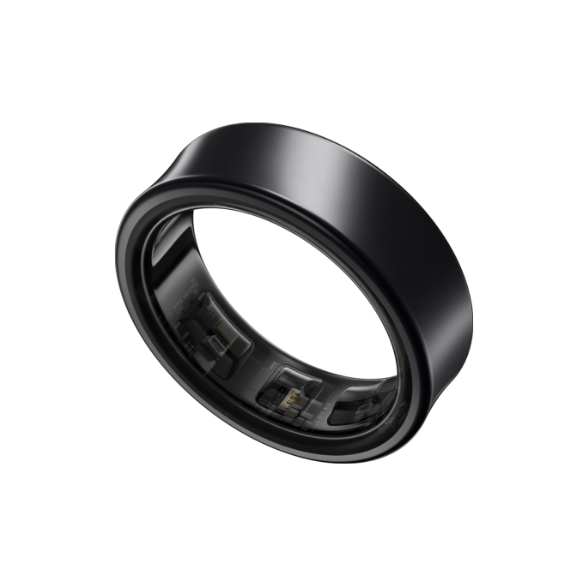
Start with the obvious one: it's tiny now. Oura cut the Ring 5's volume by about 40% versus the Ring 4 — roughly 6.1mm wide and 2.3mm thick, which puts it in wedding-band territory. Engadget's reviewer described it as far less obviously a smart ring, and that matters more than it sounds. Rings people actually keep wearing are the ones that stop announcing themselves.
Then there's the health stack. Blood Pressure Signals is the headline: overnight, the ring watches pulse-waveform patterns that correlate with blood pressure and reports whether your numbers appear to be drifting. Read that carefully, because Oura is careful about it too — the ring does not measure blood pressure. There's no cuff-grade number, no FDA clearance for measurement, and the feature isn't live in every market (UK reviewers couldn't test it at launch). What it gives you is a nightly trend line and a nudge to go get a real reading. Alongside it sits nighttime breathing-pattern analysis, 50+ tracked metrics, and — new this generation — live workout heart rate plus the ability to pair a third-party chest strap.
And the app is still the app. Oura's readiness scoring, tagging, and long-term trend views remain the most opinionated coaching in the category. Samsung Health is fine. Oura's is the one people quote to their doctor.
What Does the Galaxy Ring Still Do Better?
1. It never bills you. Every feature — Energy Score, sleep score and stages, snore detection, wellness tips, cycle tracking — ships in Samsung Health at no cost, permanently. Samsung even puts "No App Subscription" in the product title. That's not a small footnote at this price; it's most of the argument.
2. It fits more fingers. Samsung added US sizes 14 and 15 in January, so the Galaxy Ring now spans eleven sizes, 5 through 15. The Oura Ring 5 covers 6 through 13 — narrower than the Ring 4's 4–15, which caught a lot of returning Oura owners off guard. If your finger sits outside that window, the fight is over before it starts. (We wrote a whole guide on Oura Ring 5 sizing because of how often this bites people.)
3. It's built for the shower, the pool and the gym. 10ATM plus IP68 versus Oura's IP68. Both survive daily life; only one is rated for actual swimming depth. The concave outer shell also picks up fewer scratches than a flat-profile ring — worth something if you lift, though no ring loves a knurled barbell.
4. The charging case is in the box. Oura charges $99 for its case. Samsung includes one that holds extra charges and doubles as the travel container.
5. The price keeps falling. The list price is still $399.99, but $100-off promotions have been constant through 2026, putting it near $299 — and open-box stock goes lower. You're buying older hardware, and you're paying accordingly.
How Much Do They Actually Cost Over Three Years?
This is the number that decides it for most people, so here it is plainly, using the prices in front of us in July 2026:
| Three years of ownership | Galaxy Ring | Oura Ring 5 |
|---|---|---|
| Hardware | ~$299 (typical discounted price) | $399 (Silver/Black) |
| Membership × 3 years | $0 | ~$210 (at ~$69.99/yr) |
| Charging case | Included | $99 if you want one |
| Total | ~$299 | ~$609–$708 |
Call it $310 to $400 in favor of Samsung across three years — real money, and the reason a chunk of the market has moved to rings that don't charge a monthly fee at all. The counterargument is honest too: you're comparing a 2026 ring against a 2024 ring, and Oura ships genuine new capability for those fees. Nobody's being ripped off here. You're choosing which trade you'd rather make.
Which Phone Do You Have? That May Settle It
Before anything else, check this, because it disqualifies one ring outright for a lot of people:
- iPhone → Oura Ring 5, or a non-Samsung alternative. The Galaxy Ring requires Samsung Health on Android 11 or newer. There's no supported iPhone pairing, and the workarounds people post online aren't something we'd spend $300 on.
- Non-Samsung Android (Pixel, OnePlus, Motorola) → the Galaxy Ring works, and Energy Score and wellness tips work with it. What you lose is the double-pinch gesture for the camera and alarms, which needs a paired Galaxy phone. Fine trade at $299.
- Samsung Galaxy phone → this is the Galaxy Ring's home turf. Gestures, the tightest Samsung Health integration, and the sleep features Samsung tuned for its own ecosystem.
Is the Galaxy Ring Too Old to Buy in 2026?
Fair question, and we won't dodge it. The Galaxy Ring launched in July 2024. It's been two years, Samsung hasn't shipped a successor, and reporting suggests a Galaxy Ring 2 won't arrive until 2027. The sensors and the seven-day battery are exactly what they were at launch while Oura has iterated twice.
Here's the case for buying it anyway: the software has kept improving, the size range got wider, the price dropped by a hundred dollars, and none of the fundamentals — sleep tracking, Energy Score, resting heart rate, comfort — have aged badly. What you're not getting is 2026 sensor tech or anything resembling blood-pressure trends. If those matter to you, the Galaxy Ring isn't the ring; if a solid, subscription-free sleep-and-recovery tracker is what you're after, two-year-old hardware at a discount is a perfectly rational purchase.
The one scenario we'd avoid: buying a Galaxy Ring at full $399.99 list. At that price, either wait for the discount that always comes back, or step over to a RingConn Gen 3 — newer hardware, no subscription, and it goes up to size 15 too.
Galaxy Ring vs Oura Ring 5: Who Should Buy Which?
Buy the Oura Ring 5 if you…
- Use an iPhone — this decision is already made for you
- Want the most polished sleep and readiness coaching money can buy, and you'll actually read it every morning
- Care about the new cardiovascular trend features and understand they're screening nudges, not diagnoses
- Want the smallest, least noticeable ring on the market right now — and your size falls between 6 and 13
Buy the Samsung Galaxy Ring if you…
- Own an Android phone — ideally a Galaxy — and you're done paying monthly for hardware you already bought
- Need a size above 13 or below 6, where Oura simply doesn't go
- Swim, or want the sturdier 10ATM rating and the scratch-resistant concave shell
- Want the lowest three-year cost of any premium smart ring, and you can catch it near $299
Skip both if you…
- Mainly want workout heart rate — every ring struggles here; a chest strap or armband is more accurate for less money
- Aren't sure a ring beats a band for you → start with our ring vs band guide
- Want newer no-subscription hardware than the Galaxy Ring with iPhone support → RingConn Gen 3
The Bottom Line
If somebody handed us both rings for free, we'd wear the Oura Ring 5. It's smaller, it measures more, and the app does more thinking on your behalf. But nobody hands these out for free — they hand you a $399 receipt and a recurring charge, and by year three you've paid twice what the Galaxy Ring costs.
So the honest recommendation splits along a line that has nothing to do with sensors: iPhone owners and data obsessives should buy the Oura and accept the membership as the cost of the best app in the category. Android owners who want strong, quiet, subscription-free tracking should take the Galaxy Ring at its discounted price and put the $300 they saved somewhere else. And if neither answer fits — you're on iPhone and allergic to subscriptions — the RingConn Gen 3 is the ring that was built for exactly that gap. See how all three, plus every other screen-free option, stack up in our screen-free ring and band rankings.
Galaxy Ring vs Oura Ring 5 FAQ
Does the Galaxy Ring work with an iPhone?
No. It needs Samsung Health on Android 11 or newer, and Samsung doesn't support iPhone pairing. On iPhone, look at the Oura Ring 5 or RingConn Gen 3 instead.
Does the Oura Ring 5 really require a subscription?
For the full experience, yes — about $5.99/month or $69.99/year at the time of writing. Skip it and you're left with a stripped-back version of a $399 ring. The Galaxy Ring has no paid tier at all.
Can either ring actually measure blood pressure?
No. Oura's Blood Pressure Signals reads overnight pulse-waveform patterns and reports trends that correlate with blood pressure. It's a wellness feature, not a cleared medical measurement, and availability varies by country. The Galaxy Ring doesn't offer anything comparable.
Which one has better battery life?
Close. Samsung quotes up to 7 days; Oura says about a week and reviewers have seen a bit more. Bigger ring sizes hold bigger batteries in both. The practical difference: Samsung's charging case is included, Oura's costs $99.
What if my ring size is 14 or 15?
Galaxy Ring, or a RingConn Gen 3 — both go to 15. The Oura Ring 5 stops at 13, which is a step back from the Ring 4's 4–15 range. Always use the sizing kit; fingers change size through the day.
Is a Galaxy Ring 2 coming soon?
Not imminently. Samsung hasn't announced one and reporting points to 2027 at the earliest, which is part of why the current model keeps getting discounted.
Sources
- Samsung — Galaxy Ring product page (US): materials, 10ATM/IP68 rating, up-to-7-day battery, sizing kit.
- GSMArena — Galaxy Ring adds US sizes 14 and 15.
- MacRumors — Oura Ring 5 unveiled: 40% volume reduction, pricing, blood-pressure trends.
- Engadget — Oura Ring 5 review: real-world battery, membership cost, feature availability by market.