Fitbit Air Battery Life and Waterproof Rating: What Google Actually Says
Quick answer: The Google Fitbit Air is rated for up to 7 days of battery per charge. A full charge takes about 90 minutes, and 5 minutes gives about a day. It is water resistant to 50 meters, so pool swimming and rain are within spec, but Google doesn't call it waterproof and advises against hot tubs and saunas.
What are the Fitbit Air's battery and water specs at a glance?
These are the numbers Google publishes for the Google Fitbit Air, read from the Google Store spec page and Google Health Help Center on November 7, 2026.
| Spec | What Google says |
|---|---|
| Battery life | Up to 7 days per charge |
| Full charge (0 to 100%) | 90 minutes |
| Quick charge | 1 day of battery in 5 minutes |
| Battery type | Lithium-polymer |
| Charger | Magnetic USB-C charging cable (in the box) |
| Water resistance | Water resistant up to 50 meters (5 ATM per the5krunner) |
| Weight | 5.2 g tracker, 12 g with band |
| Display | None (a status light only) |
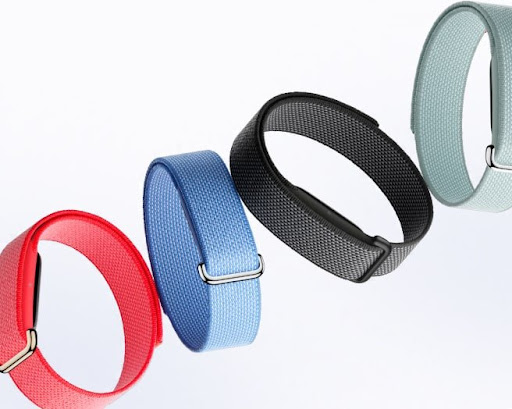
Our full Fitbit Air review covers everything else, from sleep tracking to the Premium upsell. This page is only about power and water.
How long does the Fitbit Air battery last?
Google says up to 7 days per charge, and the fine print matters. The footnote on Google's battery page says the maximum is approximate, was measured on pre-production hardware and software with default settings and a median usage profile, and that actual life may be lower.
Independent reviewers mostly landed near the claim, with a spread:
- DC Rainmaker: his unit went from 95% to 10% over a week, with 2 to 4 hours of workouts a day. By our arithmetic that works out to roughly 8 days from full to empty. He wrote that Google "nailed" the 7-day claim.
- the5krunner: called the claim possibly slightly conservative, though the review projected the 7 days from one day of use.
- Consumer Reports: still had 25% left after a full week.
- TechGuySmartBuy: only got 4 to 5 days across two weeks, with a several-mile run and weekend walks. The reviewer said lighter use might get closer to 7 days but hadn't confirmed it.
Our read, and it is an inference from those four reports, not a measurement: plan on 5 to 7 days if you exercise most days, and closer to 8 if you mostly sleep and walk. One reviewer falling well short of the claim is a data point, not proof, but it is the reason we would not buy the Air expecting a full week every time. Two other things to know. The Air saves 7 days of detailed motion data on the device, so a missed sync isn't a disaster. And a tracker that hits 0% mid-week leaves a gap in sleep data, which is the thing you bought it for.
How long does the Fitbit Air take to charge, and how do you charge it?
A full charge takes about 90 minutes, per Google, and the Air has a 5-minute quick charge that Google says gives about 1 day of battery. Google's footnote says the quick-charge result assumes in-box USB-C charging at 22 to 30 degrees C and that results may be slower.
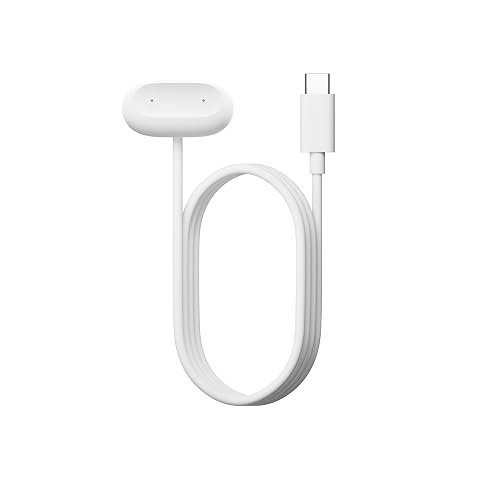
How it works, from Google's help pages:
- Plug the cable into a USB source, then hold the other end near the back of the tracker until it snaps on magnetically.
- You'll know it's connected when the tracker vibrates and the status light on its side lights up. The light pulses white while charging and turns solid white at 100%.
- To check battery without a screen, double-tap the tracker. White means more than 20%, red means less than 20%. A slow blinking red light means under 20%, and a solid red light means the battery has run out.
Two details reviewers raised. the5krunner notes the Air has to come off your wrist to charge, unlike WHOOP, whose battery pack charges the band while you wear it. And DC Rainmaker pointed out that the cable is different from any earlier Fitbit cable, so an old Charge or Luxe cable won't help (Google says the Fitbit Edge uses the same cable). The box has no wall adapter, only the USB-C cable, so use a phone charger or computer port. Google also says to use the cable that came with the device.
Since the quick charge is the Air's best battery trick, a spare cable at your desk or in a travel bag is a cheap way to avoid ever hitting red. We cover options in our best Fitbit Air bands and accessories guide.
What drains the Fitbit Air battery faster?
Google's own answer is vague: battery life "depends on features enabled, usage, environment and many other factors," and use of certain features will decrease it. Google doesn't publish an Air-specific drain list, so here is what the sources support and what we are inferring.
- Heavy exercise days. Google says workouts have "no meaningful impact" on Air battery, and DC Rainmaker's week with 2 to 4 hours of daily workouts roughly supported that. TechGuySmartBuy's shorter result came with runs, so the evidence is mixed. Our inference: the more you move, the more likely you land on the low end.
- SpO2 tracking. Google's general Fitbit battery page says SpO2 tracking "may require more frequent charging." That page covers all Fitbit devices, and the Air has SpO2 sensors, so we'd expect some effect, but Google doesn't quantify it for the Air.
- Battery age. Google says that after several hundred charge cycles a Fitbit may need charging more often. Daily quick-charging adds cycles faster than a weekly top-up, which is our inference, not a Google statement.
- Temperature. Google's general page says not to charge below 32 F (0 C) or above 113 F (45 C).
There is no screen, no always-on display and no built-in GPS on the Air, so the usual Fitbit battery killers aren't in play. That is why a 7-day claim is reasonable for a band this small. For how the Air logs workouts, see our Fitbit Air workout tracking guide.
Is the Fitbit Air waterproof?
No. Google's spec page says "water resistant up to 50 meters," and Google's help page lists the Fitbit Air among the devices water resistant to 50 meters. The word "waterproof" does not appear in that rating, and the distinction matters because water resistance isn't permanent.
Google's store footnote says the resistance comes from a surface coating that is not permanent, and Google does not guarantee it for the life of the product. the5krunner reports the rating as 5 ATM under ISO 22810. Google's help page adds that resistance may diminish over time and can be hurt by:
- dropping the device
- soaps, shampoos, conditioners, perfume, insect repellent, lotions or sunscreen
- high-velocity water, such as during water sports
The band matters as much as the tracker. Consumer Reports points out that the woven band isn't water resistant and suggests the sweatproof Active Band if you sweat heavily or get the Air wet often. the5krunner says the textile Performance Loop holds moisture and dries slowly. Google's spec page also tells you to dry the band after it gets wet. Our Fitbit Air band comparison has the options.
Can you swim, shower or use a hot tub with the Fitbit Air?
Swimming and rain are within the 50-meter rating. Showers are rated but not recommended, and hot tubs and saunas are the two things Google tells you to avoid. Here is the activity-by-activity picture.
| Situation | Fine? | What the sources say |
|---|---|---|
| Rain, handwashing, sweat | Yes | Within the 50 m rating. Dry the band afterward (Google). |
| Pool swimming | Yes, rated | DC Rainmaker wore it in a pool with no problems. No lap counting or swim mode, and the5krunner found swim heart rate poor. |
| Sea or open water | Rated, rinse after | the5krunner and DC Rainmaker wore it in the sea or open water without issues. Google says to use fresh water only to clean the band, so rinse it (our inference for saltwater). |
| Shower | Not recommended | Rated, but Google advises against it because soap, shampoo and conditioner can damage the device and irritate skin. |
| Hot tub or sauna | No | Google doesn't recommend it. Heat is not covered by the water rating (our inference). |
| Water sports, high-velocity water | Risky | Google lists high-velocity water as a way water resistance gets worse. |
| Scuba diving | Not addressed | Google gives no dive guidance. We would skip it. |
A swim caveat worth knowing: the5krunner says swim data can disappear if a workout is classed as Swim in the app, so the reviewer logs swims as runs instead. That is one reviewer's workaround, not an official Google tip. If tracked laps matter, the Air is the wrong tool, as we cover in our workout tracking guide. The short version: the Air is rated to 50 meters, it just has no swim features.
How do the Fitbit Air's battery and water rating compare with rivals?
On battery the Air is the shortest-lasting of the five screenless bands below, on charging speed it is the only one with a published 5-minute top-up, and on water it sits mid-pack: Polar rates 30 m and WHOOP IP68 to 10 m. All numbers are maker-published (WHOOP via the5krunner), read November 7, 2026.
| Band | Battery (maker claim) | Full charge | Water rating | Source |
|---|---|---|---|---|
| Google Fitbit Air | Up to 7 days | 90 min; 5 min for about a day | 50 m | Google Store |
| Amazfit Helio Strap | Up to 10 days | Under 2 hours (Amazfit Australia page) | 5 ATM | Amazfit |
| Polar Loop | Up to 8 days | Not listed on spec page | 30 m | Polar manual |
| Garmin Cirqa | Up to 10 days | Not confirmed | 5 ATM | Garmin manual |
| WHOOP 5.0 / MG | 14+ days | About 110 min (battery pack), 152 min (basic charger) | IP68, 10 m | the5krunner citing WHOOP |
WHOOP figures are from the5krunner's spec page. We couldn't open WHOOP's own pages, and WHOOP's support pages describe the water protection in less precise terms than the IP68 figure, so check WHOOP before relying on a depth.
What the table means in practice. The Helio Strap and Cirqa buy you about 3 extra days, and WHOOP about a week. The Air's edge is that charging is quick and nearly effortless, so a shorter battery matters less if you top it up regularly. WHOOP's wearable battery pack goes further, since you never take the band off at all. For the head-to-head details, see Fitbit Air vs Amazfit Helio Strap, Fitbit Air vs WHOOP 5.0 and Garmin Cirqa vs Fitbit Air. If you're weighing the Air against a Fitbit with a display, Fitbit Air vs Charge 6 covers it, and our screenless fitness tracker rankings put the whole category side by side.
Who should pick what?
- Pick the Fitbit Air if you'll charge a few minutes at a desk or while you get ready and want the lightest band (12 g). It suits pool swimmers who don't need lap tracking, and anyone who values low price over a longer battery.
- Pick the Amazfit Helio Strap or Garmin Cirqa if you want about 10 days and fewer charges. See our Helio Strap review and Cirqa review.
- Pick WHOOP if you never want to take the band off to charge, and accept the membership. How much WHOOP costs has the math.
- Skip the Air if you want a hot tub or sauna tracker, tracked swim laps, or a battery you can forget for two weeks.
Fitbit Air battery and waterproof FAQ
How long does the Fitbit Air battery last?
Google rates the Fitbit Air at up to 7 days per charge. That figure comes from pre-production testing with default settings, and Google says actual life may be lower. Independent reviewers landed between about 4 and 8 days depending on how much they exercised.
How long does the Fitbit Air take to charge?
About 90 minutes from 0 to 100% according to Google, and about 5 minutes for roughly one day of battery. It charges through a magnetic USB-C cable, and the tracker must come off your wrist while it charges.
Is the Fitbit Air waterproof?
No, Google calls it water resistant up to 50 meters, not waterproof. Google's help page also says water resistance can diminish over time, and that dropping the device or exposing it to soap, lotion, sunscreen or high-velocity water can hurt it.
Can you swim with the Fitbit Air?
Within the 50-meter rating, yes. DC Rainmaker wore it in a pool and open water without problems, and the5krunner wore it in the sea. The catch is that the Air has no swim tracking features such as lap counting, and the5krunner found swim heart rate poor.
Can you wear the Fitbit Air in the shower or a hot tub?
Google's help page advises against wearing Fitbit devices in the shower because soap, shampoo and conditioner can damage them, and doesn't recommend a hot tub or sauna. The rating covers a quick rinse. Heat and soap are what Google tells you to avoid.
How does Fitbit Air battery life compare with WHOOP and the Fitbit Charge 6?
WHOOP lists 14+ days, so it lasts about twice as long as the Air's up to 7 days. Google also lists up to 7 days for the Fitbit Charge 6, but that drops to about 3 days with the always-on display on, and to about 5 hours of continuous GPS. The Air has no display or GPS to drain it.
Does the Fitbit Air come with a charger?
Yes. Google's box list is the tracker, a wristband and a USB-C charging cable. There is no wall adapter in the box, so you need your own USB-C power source. A replacement cable is sold separately if you want a spare for a desk or travel bag.
Sources
- Tech Specs & Battery Life of Google Fitbit Air - Google Store
- Extend your Fitbit device's battery life - Google Health Help Center
- Charge your Fitbit device - Google Health Help Center
- Swim or shower with your Fitbit device - Google Health Help Center
- Fitbit Air In-Depth Review - DC Rainmaker
- Google Fitbit Air review - the5krunner
- Can the Fitbit Air Compete with the Whoop Band and the Oura Ring? - Consumer Reports
- The Fitbit Air Is Really Good - TechGuySmartBuy
- Amazfit Helio Strap - Amazfit US
- Technical specification - Polar Loop user manual
- CIRQA Owner's Manual: Specifications - Garmin
- WHOOP 5.0 / MG specs - the5krunner
Google, Polar, Garmin and Amazfit pages read November 7, 2026. Our inferences are labeled as such. Battery claims are maker figures, not our measurements.