Fitbit Air vs Amazfit Helio Strap: One's an All-Rounder, One's Built for the Gym
Quick answer: Both trackers cost around $99 and skip the subscription, but they're not really fighting for the same buyer. The Fitbit Air is the better everyday health band — 12 grams, Google Health app, AFib alerts — though DC Rainmaker's hands-on testing found its automatic activity detection reliably covers only about 5 activity types, well short of what Google's docs list. The Amazfit Helio Strap is the better gym tool — rep/set/rest tracking, a HYROX Race mode, and a standard 22mm band you can replace for about $8 — but its Zepp app is rougher and it has no on-board GPS. If you lift more than you run, buy the Helio Strap. If you want one simple band for sleep and daily health, buy the Fitbit Air.
Two $99 screenless trackers, launched months apart, both pitched as "basically WHOOP for a tenth of the price." That line is doing a lot of work for both companies, and it's exactly why people land on this comparison confused — the price is identical, the no-subscription pitch is identical, but wearing either one day to day is not the same experience at all.
We're not crowning an outright winner, because there isn't one. These two are built for different weeks. One is a background health tracker you forget is on your wrist. The other is a lifting log with a heart-rate sensor bolted on. Below is the honest breakdown of which is which.
- Best all-rounder: Fitbit Air — 12 g, Google Health app, AFib alerts, the lightest band in the category. The catch: real-world testing found auto workout detection reliably covers only about 5 activity types, despite Google's docs listing more. Our full review scored it 9.2.
- Best for gym/strength training: Amazfit Helio Strap — rep, set and rest tracking, a dedicated HYROX Race mode, and a swappable 22mm band system that costs a fraction of Fitbit's official straps. Read our full Helio Strap review.
- Stock note: both standard models were in stock on Amazon at our October 2, 2026 check. Amazfit's separate Helio Strap Pro (~$199.99, adds a waist sensor) is a pricier product, not a like-for-like swap.
Fitbit Air vs Amazfit Helio Strap: What's Actually Different?
Everything downstream of this decides itself once you answer one question: what's the tracker's job?
The Fitbit Air is built to disappear. No screen, 12 grams, one job — collect sleep, heart and rhythm data around the clock without you noticing it's there. It lives in Google Health, works on any phone, and its whole design philosophy is "the fewer decisions you make, the more consistently you wear it."
The Amazfit Helio Strap is built to survive a workout. It's heavier at 20 grams, wears on the wrist or the upper arm, and its standout features — rep counting, a HYROX mode, live heart-rate broadcast to gym equipment — only matter if you actually train with structure. Its Zepp app is less polished than Google's, but nobody buys a Helio Strap for the app; they buy it for what it does during a lifting session.
Neither has a screen, which is why they keep getting compared in the first place: nothing lighting up your wrist at 2 a.m., nothing buzzing at dinner, everything waiting in the app the next time you check.
What Does the Fitbit Air Do Well?
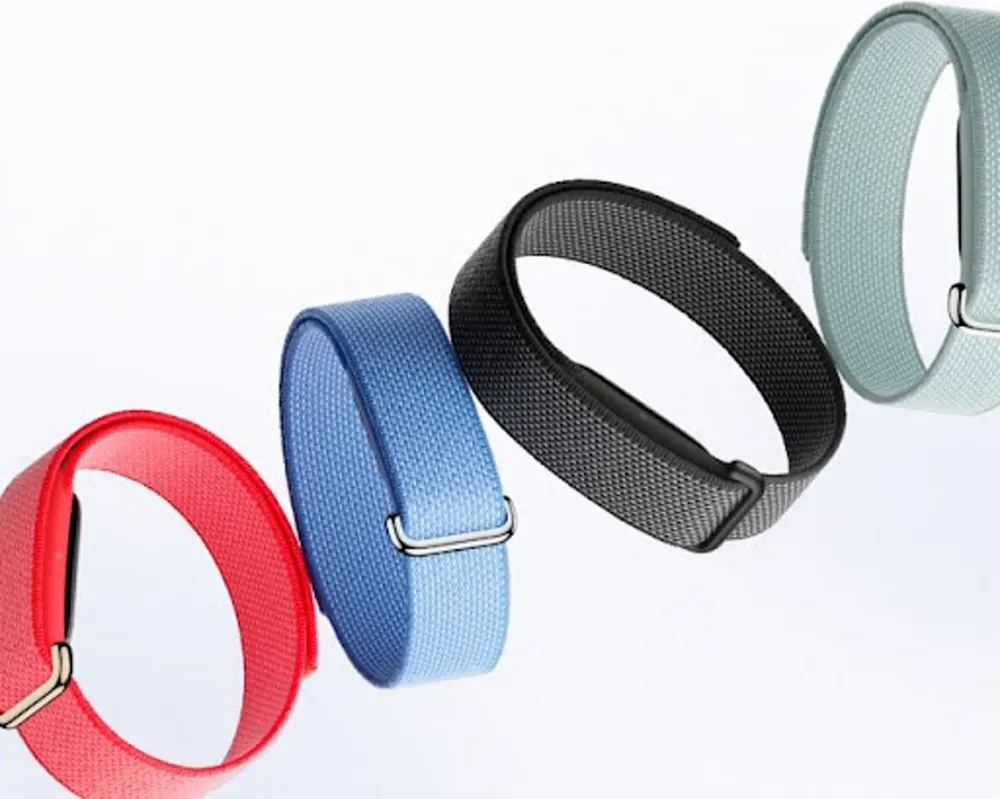
At 12 grams, the Air is less than half the weight of most trackers in this category, and "forgot I had it on" shows up in nearly every review of it. The sensor suite doesn't read like a $99 product either: 24/7 optical heart rate, SpO2, skin temperature, full sleep staging, HRV, and — the standout at this price — heart-rhythm monitoring with AFib alerts. Battery runs up to 7 days, and a 5-minute charge buys a full day, which in practice means topping it up in the shower and never actually sleeping without it.
Data lives in the new Google Health app, following the forced migration off the old Fitbit app on May 19, 2026 — we cover what changed and the migration headaches in our Fitbit app to Google Health guide. Core tracking is free forever; an optional Google Health Premium tier ($9.99/mo or $99/yr, with a 3-month trial included) adds Gemini-based AI coaching on top.
The honest catch, and it's the one nobody advertises: Google's own support documentation lists 7 auto-detected activity types for the Air — walk, run, bike, sports, elliptical, rowing machine and stationary bike — but DC Rainmaker's hands-on testing found the Air reliably auto-categorized only about 5 of them (walk, run, bike, elliptical, rowing). Squat, deadlift, HYROX-style circuits, most machine work? None of it gets auto-logged either way. You either start it manually from your phone before a set (which nobody does) or it just doesn't show up. For a background health tracker that's a minor footnote. For anyone hoping it doubles as a training log, it's the reason to keep reading.
What Does the Amazfit Helio Strap Do Well?
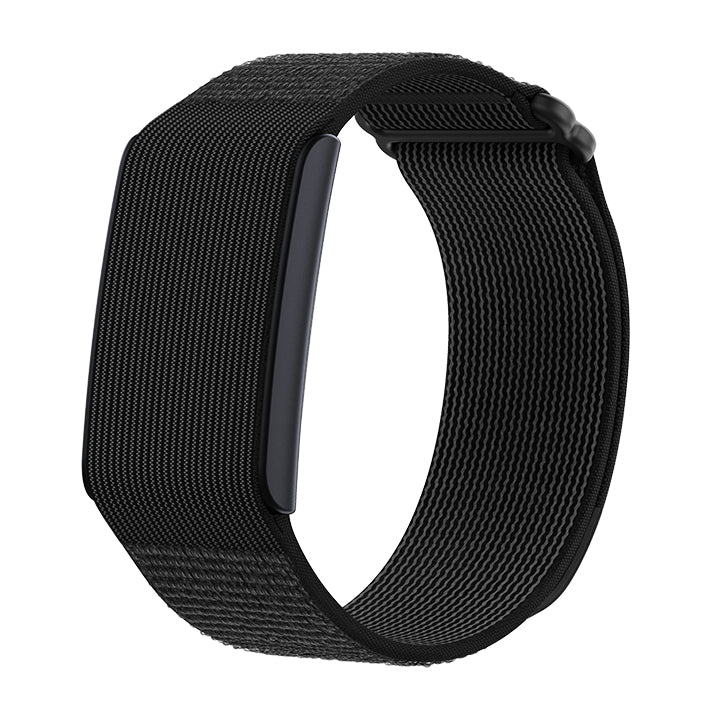
The Helio Strap's whole reason for existing is the gym. It tracks strength training with reps, sets and rest periods, runs a dedicated HYROX Race mode — a first in this price bracket — and can broadcast live heart rate to gym equipment and other apps, a feature usually reserved for chest straps. Wear it on the upper arm (officially supported, with a strap extension to match) and heart-rate accuracy during lifts and intervals improves noticeably, because bicep placement sidesteps the wrist flexion and grip tension that mess with optical sensors mid-set. We go deeper on why placement matters in our chest strap vs armband vs wrist accuracy guide.
The tracker itself — Amazfit calls it the Helio Core — is a removable module that snaps into a middle frame the band threads through, rated 5 ATM and running up to 10 days per charge, three days longer than the Air. It talks to Amazfit's Zepp app, which holds every recovery metric WHOOP built its subscription around — readiness, HRV, sleep staging, training load — free, forever, no paywall.
The part most reviews skip: the Helio Strap uses a standard 22mm quick-release band, the same fitting as the Amazfit Balance, Balance 2, T-Rex 3 and Bip 5/6. That means the entire aftermarket for those watches works on it too, and third-party straps start around $8 — genuinely standard hardware, unlike WHOOP's proprietary clasp system. We map out every band option (and the "band only" catch that trips people up) in our Helio Strap bands guide.
The honest catches: no on-board GPS (it borrows your phone's for outdoor routes), and the Zepp app, while improving fast, is still a step behind Google Health's simplicity and Garmin Connect's polish. Expect a busier layout and occasional rough edges in the copy.
Bands and Accessories: Which One Is Cheaper to Customize?
This is where the gap gets big, and it's worth knowing before you buy either one.
The Fitbit Air ships on a fabric Performance Loop and only has three official styles: the Performance Loop (fabric, ~$34.99), the Active silicone band (~$34.99, small and large, the one to buy for sweat), and the Elevated Modern polyurethane band with a stainless steel clasp (~$49.99, the office-appropriate option). All three snap onto the same proprietary pod — there's no 22mm-style aftermarket here, so third-party bands are a smaller, less consistent market. We rank all three in our Fitbit Air bands guide.
The Helio Strap uses that standard 22mm quick-release fitting mentioned above, so replacement bands run from around $8 for basic silicone up to about $15 for one that ships with its own frame case. That's the Amazfit ecosystem's whole appeal in one sentence: cheap, standard, and not locked to one manufacturer's storefront.
| Bands | Fitbit Air | Amazfit Helio Strap |
|---|---|---|
| Fitting | Proprietary pod | Standard 22mm quick-release |
| Official styles | 3 (Performance Loop, Active, Elevated Modern) | 1 stock nylon; wide 22mm aftermarket |
| Cheapest replacement* | ~$34.99 | ~$8 |
| Cross-compatible with | Nothing else | Amazfit Balance, Balance 2, T-Rex 3, Bip 5/6 |
| Official arm band | Not offered | Yes (~$19.99, Amazfit's own store) |
*Reference prices at the time of writing; check live listings.
Which Tracks Workouts Better in the Gym?
Neither is a running watch, so let's be precise about what "better" means here: not GPS accuracy, but whether the tracker actually understands what you're doing during a session.
The Helio Strap wins on intent — rep/set/rest logging and a HYROX mode don't exist on the Air at all — but DC Rainmaker's August 2026 accuracy testing found real quirks worth knowing before you rely on it. The Helio is "really good at detecting elevated HR, but can't detect workout types and often prematurely ends things," and it will split a single session into two entries "the moment you slow down for 90 seconds" — annoying if you rest between HYROX stations. It also nailed a 500-step test almost exactly (505 recorded), but on active days it converts non-step workouts like cycling into steps using its own formula, which inflates daily totals versus what actually happened.
The Fitbit Air's limitation is simpler and more fundamental: Google lists 7 auto-detected activity types on paper, but DC Rainmaker's hands-on testing found reliable categorization for only about 5 of them — and strength or circuit work isn't one of the categories either way, so that work never gets logged automatically at all. DCR's testing found the Air was the only device in its comparison to score a 500-step count exactly, and its heart-rate accuracy during workouts was broadly comparable to WHOOP's — but manual workout tracking and GPS recording were buggy, and elevation data showed zero.
Translation: if the plan is structured lifting or HYROX-style training, the Helio Strap's rep-tracking and arm-wear option get you real data the Air simply doesn't attempt to collect. If the plan is walking, running or cycling with the occasional gym session, the Air's auto-detected categories cover most of what you'll actually do.
Fitbit Air vs Amazfit Helio Strap: Spec Comparison
| Feature | Fitbit Air | Amazfit Helio Strap |
|---|---|---|
| Price (list)* | ~$99.99 | ~$99.99 |
| Subscription | Optional (core data free) | None — everything free |
| Weight | 12 g | ~20 g (module) |
| Battery | Up to 7 days; 5-min charge = 1 day | Up to 10 days |
| Water rating | Not officially rated for swimming | 5 ATM |
| Wear position | Wrist only (ankle possible, unofficial; see the data) | Wrist or upper arm |
| Auto workout types | 7 listed by Google; ~5 reliable in testing (walk, run, bike, elliptical, rowing) | Broad detection, but weak on workout type |
| Strength/HYROX tracking | ❌ None | ✅ Reps, sets, rest + HYROX mode |
| AFib / heart-rhythm alerts | ✅ Included | ❌ Not offered |
| GPS | Phone-connected | Phone-connected |
| Band fitting | Proprietary, 3 official styles ($34.99–$49.99) | Standard 22mm, aftermarket from ~$8 |
| App | Google Health | Zepp |
| Phone support | ✅ iOS + Android | ✅ iOS + Android |
*List prices at the time of writing (August 2026) — check live listings. Amazon's price at checkout governs.
The Annoyances, Honestly
Fitbit Air
- ✓ 12 g — you'll genuinely forget it's on
- ✓ AFib alerts included, no extra cost
- ✓ Core data free forever in Google Health
- ✓ 5-minute fast charge covers a full day
- ✓ Simplest app of the two, no learning curve
- ✕ Automatic activity detection is narrower in practice than Google's docs suggest — most gym work isn't logged automatically
- ✕ Wrist-only; no armband option for lifting
- ✕ No strength or HYROX tracking whatsoever
Amazfit Helio Strap
- ✓ Rep, set and rest tracking + HYROX Race mode
- ✓ 10-day battery, longest in the ~$99 class
- ✓ Wrist or upper-arm wear, 5 ATM
- ✓ Standard 22mm bands from ~$8 — cheapest ecosystem here
- ✓ Zero paywall, ever — everything free in Zepp
- ✕ Zepp app rougher than Google Health or Garmin Connect
- ✕ Detects elevated heart rate well but often misreads workout type, per DCR testing
- ✕ No AFib or heart-rhythm alerts
- ✕ Stock has been patchy: it sold out again within weeks of a mid-August restock
Who Should Buy the Fitbit Air?
- You want sleep, heart and AFib data without thinking about the tracker at all
- Your workouts are mostly walking, running or cycling — those are exactly the activity types the Air reliably auto-detects
- You'd rather have the simplest app of the two and don't mind an optional subscription for extra coaching
- You already wear a watch for training and just want a background sleep/health layer
Who Should Buy the Amazfit Helio Strap?
- You lift, do CrossFit or HYROX, and want rep/set/rest data a wrist-only tracker can't give you
- You want WHOOP-style recovery scores with zero subscription, ever
- You'd rather pay $8 for a spare band than $35–$50, and like having options beyond one brand's storefront
- You're fine wearing it on your upper arm for cleaner heart rate during hard sessions
Fitbit Air vs Amazfit Helio Strap? Bottom Line
Neither of these beats the other outright, and that's the actual finding here, not a cop-out. The Fitbit Air is the tracker to buy if your life is mostly walking, sleeping and the occasional run — it's lighter, its app is simpler, and it adds AFib screening the Helio Strap doesn't even attempt. The Amazfit Helio Strap is the tracker to buy if your calendar has squat days on it — nothing else near $99 logs reps and sets, runs a HYROX mode, or lets you swap in an $8 band instead of a $35 one.
Fitbit Air vs Amazfit Helio Strap FAQ
Is the Fitbit Air or Amazfit Helio Strap better for the gym?
The Helio Strap. It tracks reps, sets and rest periods, has a HYROX Race mode, and can be worn on the upper arm for cleaner heart rate during lifts. Google's support page lists 7 auto-detected activity types for the Fitbit Air, but DC Rainmaker's hands-on testing found reliable categorization for only about 5 (walk, run, bike, elliptical, rowing) — so most strength training has to be logged manually or not at all.
Which has the longer battery life?
The Helio Strap, at up to 10 days versus the Air's up to 7. The Air's fast charge is quicker in a pinch — 5 minutes buys about a day.
Do either require a subscription?
No. Both are free forever for core data — Google Health for the Air, Zepp for the Helio Strap. The Air has an optional Premium tier for AI coaching; nothing on the Helio Strap is paywalled.
Can I put a cheap replacement band on either one?
Mostly just the Helio Strap — it uses a standard 22mm quick-release fitting, so third-party bands start around $8. The Fitbit Air only fits Google's three official bands, priced $34.99 to $49.99.
What if the Fitbit Air or Helio Strap is out of stock when I click?
For the Fitbit Air, the Stephen Curry Special Edition ($129.99 list) is the same tracker with a different band, so it's the fallback if the standard listing shows unavailable. The Helio Strap has sold out between restocks in 2026; Amazfit's Helio Strap Pro (~$199.99) is a pricier, different product rather than a like-for-like swap, so if you want the standard band, wait for the restock.
Which is more accurate?
DC Rainmaker's testing puts both in roughly the same accuracy bucket as WHOOP and Garmin, each with quirks — the Helio Strap sometimes splits workouts or inflates step counts from non-step activity, while the Air's manual workout GPS logging has been buggy. For resting heart rate and sleep, both are solid.
Sources
- DC Rainmaker — Fitbit Air In-Depth Review: A True Whoop Competitor for $99?: activity-type detection, workout HR findings, GPS/elevation bugs.
- DC Rainmaker — Accuracy Deep-Dive: Cirqa vs Whoop 5.0, Fitbit Air, Helio, Polar Loop: Helio Strap step-count and workout-splitting quirks, Fitbit Air step-count accuracy.
- Google Health Help Center — What activities do my Fitbit device and Google Pixel Watch track: auto-detected activity categories.
- Amazfit — Helio Strap product page (US): 22mm band width, 5 ATM rating, 10-day battery, in-box contents.