Garmin Index Sleep Monitor Review (2026): Is the $169.99 Sleep Band Still Worth It After Cirqa?
Quick answer: The Garmin Index Sleep Monitor is worth its $169.99 list price if you already train with a Garmin watch and can't stand sleeping in it. It feeds Garmin's sleep, HRV and Training Readiness numbers from a soft armband you barely notice. If you don't own a Garmin watch, the $199.99 Garmin Cirqa does more for $30 extra.1, 2, 3
Plenty of Garmin owners take the watch off at night because it feels like a brick on the wrist at 2 a.m. Then Garmin Connect has no idea how they slept, and Training Readiness, HRV status and Body Battery are left working with half the data.4
The Index Sleep Monitor, announced June 18, 2025, was Garmin's fix: a small sensor module in a stretchy sleeve that goes on your upper arm at night and syncs everything back in the morning.5 Then on July 21, 2026, Garmin launched the Cirqa, a screenless band that tracks your whole day and can also be worn on the arm.3 That changed who the Index makes sense for, and most Index reviews came out a year before the Cirqa existed, so they can't answer it.
- Buy it if you own a Garmin watch, care about Training Readiness and HRV status, and won't wear the watch to bed. Comfort is the thing reviewers and owners praise most.
- Skip it if you don't own a Garmin watch. Body Battery and Training Readiness need one, and the Cirqa covers day and night for $199.99.
- Battery: Garmin says up to 7 nights. Reviewers got anywhere from about 4 to 9, so learn your own number before you trust it on a trip.
- No subscription. Garmin Connect+ ($6.99 a month) is optional and adds little for sleep.
- Common gripes: some owners get missed or unsynced nights, alarms are a chore to set, and it won't record naps.
How Does the Garmin Index Sleep Monitor Compare With Cirqa, Fitbit Air, WHOOP and Oura?
The Garmin Index Sleep Monitor is the only one of these five built purely for sleep: it costs $169.99 once, goes on your upper arm, and skips steps and workouts entirely.1, 6, 7, 8, 9
| Garmin Index Sleep Monitor | Garmin Cirqa | Google Fitbit Air | WHOOP 5.0 (One plan) | Oura Ring 5 | |
|---|---|---|---|---|---|
| List price (October 2026) | $169.99 | $199.99 | $99.99 | Band included with membership | $399 (Silver, Black) |
| Required fee | None; Connect+ optional | None; Connect+ optional | None; Premium optional, $9.99/month | $199/year (One) up to $359/year (Life), May 2025 pricing | $5.99/month or $69.99/year; little works without it |
| Where you wear it to sleep | Upper arm only | Wrist, or upper arm with a $59.99 band | Wrist | Wrist, or bicep with WHOOP's bicep band | Finger |
| Battery (maker's claim) | Up to 7 nights | Up to 10 days | Up to a week | 14 days | 6 to 9 days |
| Tracks your day and workouts | No, sleep only | Yes | Yes | Yes | Yes |
| Needs another device for its full data | A Garmin watch for Body Battery and Training Readiness | No | No | No | No |
| 3-year cost (USD) | $170 | $200 ($260 with arm band) | $100 | $597 | $609 |
Garmin, Google and Oura prices from their own stores, checked October 3, 2026; WHOOP's tiers are its May 2025 launch prices as reported by CNBC. The 3-year math is explained further down.4, 10, 11, 12
What Is the Garmin Index Sleep Monitor?
The Garmin Index Sleep Monitor is a screenless sleep tracker: a 14.5-gram sensor module that slides into a soft, machine-washable sleeve you wear on your upper arm at night. It has no display and no buttons, and it syncs to the free Garmin Connect app on iPhone or Android when you take it off in the morning.1, 13
| Spec | Garmin Index Sleep Monitor |
|---|---|
| Garmin list price (October 3, 2026) | $169.99 for either size |
| Sizes (upper-arm circumference) | S–M: 20 to 29 cm (8.0 to 11.7 in) · L–XL: 26 to 42 cm (10.5 to 16.6 in) |
| Weight | Module 14.5 g · sleeve 15.8 g (S–M) or 20.0 g (L–XL) |
| Module size | 41.7 × 37.6 × 7.8 mm |
| Band material | 70% nylon, 30% spandex, hook-and-loop closure |
| Battery (Garmin's claim) | Up to 7 nights with Pulse Ox on, assuming 8 hours of sleep |
| Charging | Garmin proprietary cable to USB; up to 2 hours for a full charge |
| Water rating | 5 ATM (the module must come out before the sleeve goes in the wash) |
| Sensors | Optical heart rate with Pulse Ox, skin temperature, accelerometer (used for sleep) |
| Alarm | Vibrating, with an optional Smart Wake window of up to 30 minutes |
| Subscription | None required |
From Garmin's press release, product page and owner's manual, checked October 3, 2026.1, 2, 5, 13
Garmin is still updating it. Software 3.82 in November 2025 added support for Garmin's Health Status feature, and version 3.93 arrived on August 17, 2026 with "minor fixes and improvements."14
Does the Garmin Index Sleep Monitor Need a Garmin Watch?
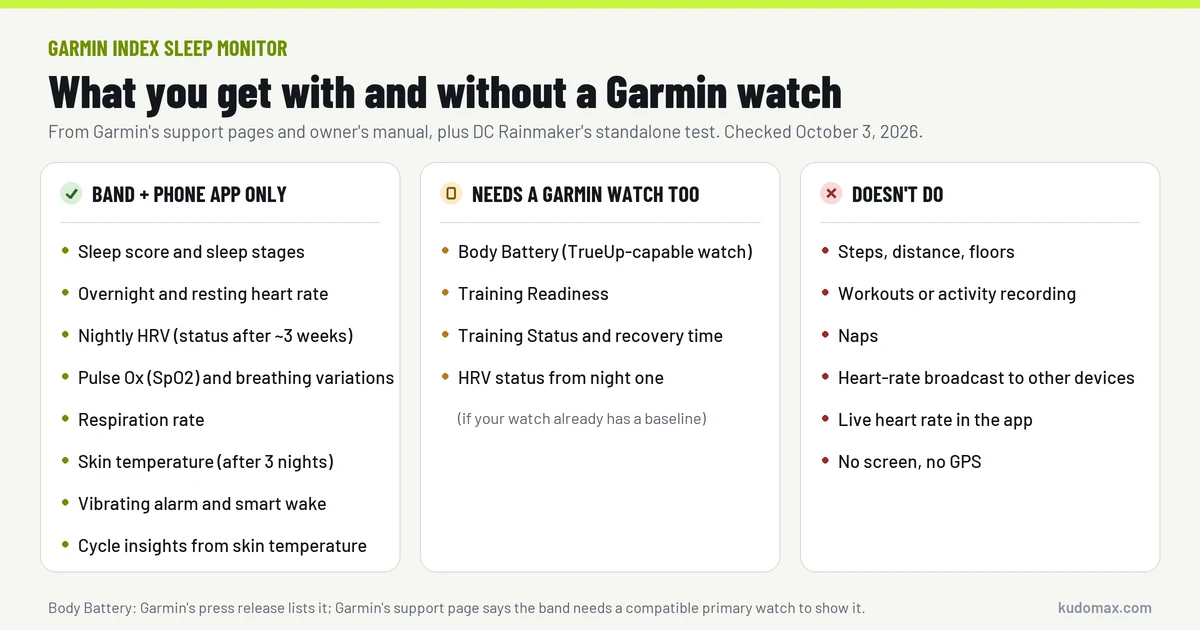
No. The Garmin Index Sleep Monitor pairs directly with the free Garmin Connect app on your phone and records your sleep on its own. A few of Garmin's headline numbers, though, only appear when a compatible Garmin watch is also on your account, and Body Battery and Training Readiness are the big two.4, 13, 15, 16
What you get with just the band and your phone
With nothing but the band and Garmin Connect, you get a sleep score from 0 to 100, light, deep and REM stages, restless moments, overnight and resting heart rate, average and lowest SpO2, breathing variations, respiration and the change in your skin temperature, which also feeds Garmin's period predictions and past ovulation estimates. Garmin files overnight stress under Body Battery data, so it may need a watch too.5, 15 HRV takes patience: your nightly HRV average shows up right away, but the HRV status needs three weeks of consistent nights unless a watch has already built your baseline, and skin temperature reads "calibrating" for the first three nights.13, 15 DC Rainmaker, who tested it at launch, put it plainly: "you don't need a Garmin watch at all to use it."4
What needs a Garmin watch
- Body Battery. Garmin's support page says Body Battery data from the band needs a primary wearable that supports Body Battery TrueUp,15 even though the launch announcement listed it as a band feature.5 With no Garmin watch, don't count on it.
- Training Readiness and Training Status. The band's sleep data updates recovery time and Training Readiness,2 but in DC Rainmaker's 24-hour test the score stayed blank until his switched-off watch was turned on and synced; at the time, the band couldn't be set as a "primary wearable" itself.16
- HRV status from night one. If your watch already has an HRV baseline, the band updates your status the first night.15
How Long Does the Garmin Index Sleep Monitor Battery Last?
Garmin rates the Index Sleep Monitor at up to 7 nights per charge with Pulse Ox on, assuming 8 hours of sleep a night. Published reviews and owners report anywhere from about 4 nights to 9.1, 4, 17, 18
| Who measured it | Nights per charge | Conditions |
|---|---|---|
| Garmin (official claim) | Up to 7 | 8 hours of sleep a night, Pulse Ox on |
| DC Rainmaker (June 2025) | About 8 to 9 | Typically 6 to 8 hours of wear a night |
| Wareable (September 2025) | About 4 (roughly 25% a night) | 7 to 9 hours a night; a 6-hour sleeper got one more night |
| An owner on r/Garmin (August 2026) | Never more than 5 | Ran flat mid-sleep in the first week |
Each row is one reviewer or one owner; nobody has lab-tested the battery.1, 4, 17, 18
Garmin says alarm vibration strength and sleep length both affect the total; Wareable's reviewer suspected the always-on overnight Pulse Ox, which he couldn't turn off in 2025.2, 13, 17 Left on after you get up, it used about 1% an hour in DC Rainmaker's all-day test.16 A full charge takes up to 2 hours, so until you know your own number, top it up every third morning.13
Is the Garmin Index Sleep Monitor Accurate?
For when you fell asleep and woke up, the Garmin Index Sleep Monitor holds up well in published side-by-side tests. For sleep stages, nobody has published a lab study of the Index itself as of October 2026, so treat its REM and deep sleep minutes as estimates.4, 17
- DC Rainmaker, against four other wearables. On a normal night the Index logged 12:21 to 7:56 a.m. against his actual 12:20 to about 8:00, in line with a Venu 3, WHOOP MG, Oura ring and Apple Watch Ultra 2. When he lay awake after an early wake-up, the two Garmins and the Apple Watch caught it, while the WHOOP and the Oura added 30 to 40 minutes of sleep.4
- Wareable, 43 nights. Conor Allison's Index averaged 3 hours 6 minutes of deep plus REM sleep against 3 hours 1 minute on his WHOOP over the same stretch; in an earlier 14-night baseline, a Forerunner 970 had undercounted it by about 30 minutes a night. One night still showed just 20 minutes of deep sleep.17
- Owners. A recurring complaint is HRV running lower, and sleeping heart rate a little higher, than on their Garmin watch; one owner says it settled after calibrating. Another thread worried about getting only around 30 minutes of REM a night.18
Lab research explains why stages are the soft spot. A 2025 study of 62 adults found six wrist wearables, including an older Garmin band, correctly flagged more than 90% of sleep but identified only 29% to 52% of time awake; the Garmin's agreement with the sleep lab was the lowest of the group, and it overestimated total sleep by about 38 minutes.19 A 2024 study of an Oura Ring Gen3, Fitbit Sense 2 and Apple Watch Series 8 found the same pattern: at least 95% of sleep caught, but 50% to 86% sensitivity once you split it into stages. Oura funded that study, and the lead author sits on Oura's medical advisory board.20 Neither tested the Index, which sits on your upper arm, a spot that tends to be kinder to optical sensors than the wrist, at least during exercise (our chest strap vs armband vs wrist guide covers why). Watch total sleep, bedtime and the two-week trend rather than one night's REM number.
Is the Index Sleep Monitor Comfortable to Sleep In, and How Do You Wear It?
Comfort is the one thing nearly everyone agrees on: a wide, very thin sleeve you stop noticing after a few nights. DC Rainmaker, who'd worn a WHOOP bicep band nightly for about five years, called the difference astonishing and weighed his S–M at 31 grams, the same as a WHOOP 5.0 on its bicep band.4
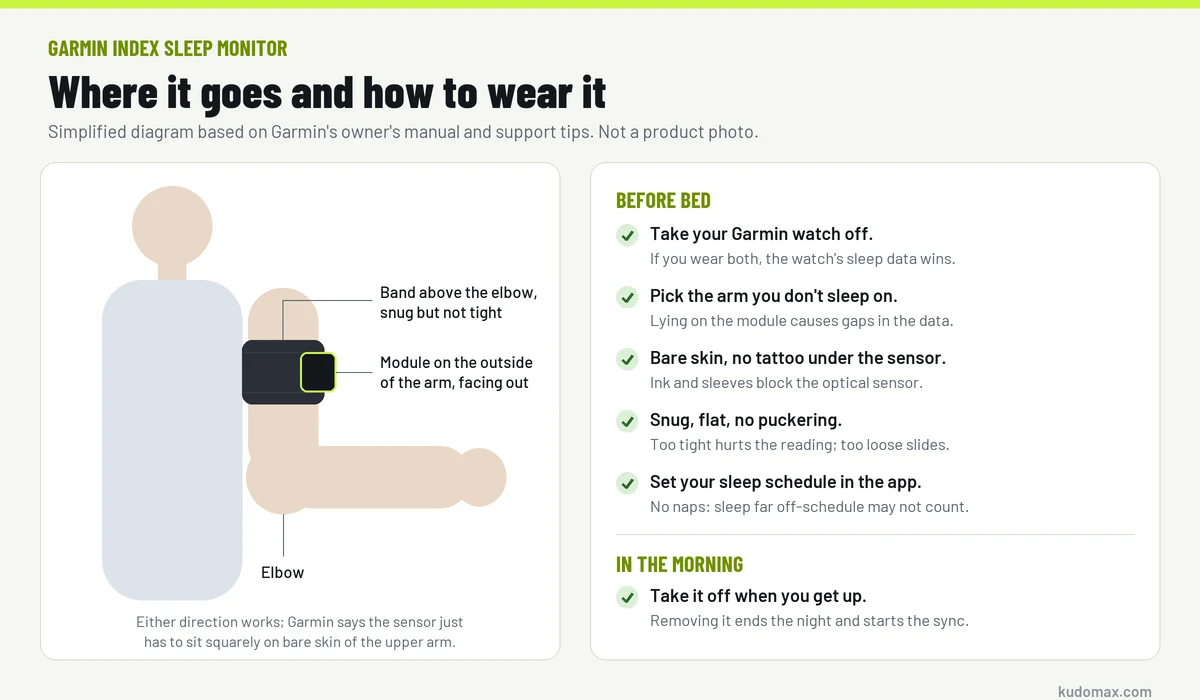
Slide the band above your elbow, keep the module on the outside of your arm (or nudge it toward the inside if that's more comfortable), and make it lightly snug, flat against the skin with no puckering. Don't lie directly on the module, wear it on bare skin, since Garmin says a band worn over clothing may not record your sleep, and keep the sensor off tattoos, which can block its light. Which way round it goes doesn't matter.2, 13, 15, 21 Garmin also warns that some people get skin irritation from long wear, so keep the band clean and dry and don't overtighten it.13
Not everyone finds the fit easy. Wareable's reviewer thought the sleeve was wider than it needs to be, and other testers on his team had occasional nights with missing data from a poor fit.17 Several owners on r/Garmin say it slides down toward the elbow overnight; one woke up to a record of only about 4 hours that way, and the short night dragged their HRV average for a few days. Others say it stays put.18
What Do Owners Complain About Most?
Missed or unsynced nights top the list, followed by battery life and alarms. Owner reports are anecdotes and say nothing about how often problems happen, but these themes repeat across a year of threads.18
Missed nights and syncing
One owner gets a few nights a month where Garmin Connect says no sleep was detected, even after a factory reset and a replacement unit, and called a tracker that works nine nights out of ten not good enough. Another has had to factory-reset theirs at least three times. For others, a firmware update fixed syncing, and at least one owner hasn't missed a night since launch.18 Garmin's own list of reasons a night isn't recorded includes sleep under three hours, a flat battery, tattoos, wearing it over clothing, a band too tight or too loose, very poor sleep, sleeping far outside your set schedule, and a wrong phone clock.15 Taking the band off is what ends the night and starts the sync, so keep the Garmin Connect app running nearby when you do.4, 13
Alarms
The silent vibration gets real praise from people who share a bed; it wakes you without waking anyone else.18 Setting it is another story: the band has to be on and connected, and the alarm sits several taps deep in Garmin Connect, which DC Rainmaker and an August 2026 owner both found tedious when wake-up times vary.4, 18 In June 2025, DC Rainmaker also found that snoozing with a double tap ended the night's sleep recording at the first snooze; we couldn't confirm whether a later update fixed that.4 A September 2026 owner said an alarm they'd switched off months earlier went off on its own, and another found the Smart Wake buzz too faint to notice.18
Garmin Index Sleep Monitor vs Garmin Cirqa: Which Should You Buy?
Buy the Garmin Cirqa if you don't already own a Garmin watch; buy the Index Sleep Monitor if you do and only want better nights. The Cirqa costs $30 more, or $90 more with its $59.99 Upper Arm band, and adds steps, workouts and naps, while the Index does one job in a wider, thinner sleeve. Our Garmin Index Sleep Monitor vs Cirqa comparison covers whose sleep counts when both are on one Garmin account, the two arm bands side by side, and the 3-year cost of each setup.1, 3, 6, 22
Our full Garmin Cirqa review covers its weak spots, and the Cirqa accessories guide covers the bands.
Garmin Index Sleep Monitor vs WHOOP and Oura: Which Is Better for Sleep?
On cost, the Garmin Index Sleep Monitor wins easily: $169.99 once, against about $597 for three years of WHOOP One or about $609 for an Oura Ring 5 with its membership. On the sleep data itself the gap is smaller than the prices suggest, and WHOOP and Oura track your whole day, which the Index doesn't.1, 8, 9, 12, 17
| Setup (USD; Garmin, Google and Oura list prices October 3, 2026) | Upfront | After 1 year | After 2 years | After 3 years |
|---|---|---|---|---|
| Garmin Index Sleep Monitor | $169.99 | $170 | $170 | $170 |
| Google Fitbit Air, free app | $99.99 | $100 | $100 | $100 |
| Garmin Cirqa (wrist band) | $199.99 | $200 | $200 | $200 |
| Garmin Cirqa + Upper Arm band | $259.98 | $260 | $260 | $260 |
| WHOOP One (WHOOP 5.0 included; May 2025 launch price) | $199 | $199 | $398 | $597 |
| Oura Ring 5 Silver or Black + membership (yearly plan) | $399 | $469 | $539 | $609 |
How we calculated it: device list price plus each required yearly fee, with each column showing the total you've paid by the end of that year. WHOOP One is billed yearly up front at $199 (May 2025 launch pricing via CNBC); Oura's membership is $69.99 a year after one included month. Optional Garmin Connect+ and Google Health Premium, sales tax, spare bands and chargers aren't included.1, 6, 7, 8, 9, 12
Garmin Index Sleep Monitor vs WHOOP
WHOOP sells its band only as part of an annual membership, from $199 a year for WHOOP One to $359 for WHOOP Life at May 2025 launch prices, and the WHOOP 5.0 is rated for 14 days per charge, twice the Index's claim.8 It's built for 24/7 wear: in DC Rainmaker's all-day test WHOOP captured his workout heart rate during a trainer ride while the Index missed the peaks.16 For sleep alone, the Index held its own in Wareable's 43 nights, matching WHOOP's deep-plus-REM average within five minutes.17 Garmin users eyeing WHOOP mainly for sleep can skip the yearly bill with the Index or the Cirqa; our Garmin Cirqa vs WHOOP comparison and best WHOOP alternatives go deeper.
Garmin Index Sleep Monitor vs Oura Ring
The Oura Ring 5 costs $399 in Silver or Black and lasts 6 to 9 days, and without Oura's $5.99-a-month membership you see little beyond three daily scores.9, 12 One owner who swapped an Oura Gen 2 for the Index to drop the subscription found the data practically matched, though Oura did catch the moment they fell asleep, and their sleep duration, better.18 A ring also leaves both arms and wrists free. Our Fitbit Air vs Oura Ring 5 comparison runs Oura against a cheaper band.
Who Should Buy the Garmin Index Sleep Monitor, and Who Shouldn't?
Buy the Garmin Index Sleep Monitor if you already own a Garmin watch and want sleep data without sleeping in it; most other people are better served by the Cirqa, a Fitbit Air, WHOOP or a ring. Start at the top and stop at the first line that fits you:
- You own a Garmin watch, train by Training Readiness or HRV status, and can't sleep in the watch → Index Sleep Monitor.
- You don't own a Garmin watch → Garmin Cirqa. You'd be paying $169.99 for a band that can't show Body Battery or Training Readiness on its own.
- You want Garmin data all day but hate anything on your wrist at night → Cirqa plus the $59.99 Upper Arm band, or your watch by day and the Index at night.
- You nap, work nights or rotate shifts → Skip the Index. It doesn't record naps and leans on a set sleep schedule.2, 15
- You want accurate workout heart rate → Not the Index, which can't record workouts or broadcast heart rate. Use your watch or a chest strap.
- You want coaching and don't mind a yearly bill → WHOOP.
- You'd rather wear a ring → Oura Ring 5, budgeting for the membership.
- Both upper arms are tattooed where the sensor would sit → Skip it. Garmin says ink can block the readings.2
A sleep tracker tells you how you slept; it won't fix it. If the Index keeps handing you scores in the 50s, our guide to what to buy when your sleep score is bad covers the fixes that tend to move the number. Still choosing a band? Start with our screenless fitness tracker rankings or our Fitbit Air review, the cheapest serious option.
Garmin Index Sleep Monitor FAQ
Does the Garmin Index Sleep Monitor need a Garmin watch?
No. It pairs with the free Garmin Connect app and records sleep score, stages, heart rate, HRV, SpO2, breathing variations and skin temperature on its own. Garmin's support pages say Body Battery needs a compatible primary watch, and DC Rainmaker found Training Readiness only updates when your watch syncs too.4, 15, 16
Does the Index Sleep Monitor need a subscription?
No. Every sleep metric it records is free in Garmin Connect. Garmin Connect+ costs $6.99 a month or $69.99 a year as of October 2026, and DC Rainmaker found nothing in it that meaningfully uses the Index Sleep Monitor on its own, since its extras lean on activity data the band doesn't record.4, 10
How long does the Garmin Index Sleep Monitor battery last?
Garmin says up to 7 nights with Pulse Ox on, based on 8 hours of sleep a night. DC Rainmaker got about 8 to 9 nights, Wareable about 4, and one owner never more than 5. A full charge takes up to 2 hours on Garmin's proprietary cable.1, 4, 13, 17, 18
Can the Index Sleep Monitor track naps?
No. Garmin says the Index Sleep Monitor doesn't record naps and works best at or near the sleep schedule you set in Garmin Connect. Sleep under three hours, or sleep far outside that schedule, may not be recorded at all. The Garmin Cirqa lists nap detection if naps matter to you.2, 3, 15
Can you wear the Index Sleep Monitor all day?
You can, but it's built for sleep. In DC Rainmaker's 24-hour test, heart rate, stress, SpO2, respiration and calories came through during the day, but there were no steps, intensity minutes or recorded workouts, and the battery dropped about 1% an hour. Garmin says it can't record activities.2, 16
Can you wash the Garmin Index Sleep Monitor?
The sleeve, yes; the module, no. Take the module out, fasten the hook-and-loop closures, put the band in a mesh laundry bag and wash it on a gentle cycle no warmer than 40°C (104°F), with mild detergent and no bleach or fabric softener. Hang it or lay it flat to dry.13
What size Index Sleep Monitor should I get?
Measure around your upper arm. The S–M fits 20 to 29 cm (8.0 to 11.7 in) and the L–XL fits 26 to 42 cm (10.5 to 16.6 in); both cost $169.99 at Garmin. DC Rainmaker, who could fit either, chose the S–M because the L–XL left extra strap flopping around.1, 4
Can I wear my Garmin watch and the Index Sleep Monitor at the same time?
You can, but your sleep data will come from the watch instead of the Index. Garmin recommends taking the watch off before bed, keeping its heart rate sensor uncovered or on the charger, and leaving it powered on for at least 15 minutes so the two devices sync properly.2, 21
Is the Garmin Index Sleep Monitor worth it in 2026?
For Garmin watch owners who won't sleep in their watch, yes: it's the most comfortable way to keep Training Readiness, HRV status and sleep coaching fed, with no subscription. Without a Garmin watch, the $199.99 Cirqa is the better buy, since it tracks your day too and works fully on its own.2, 3, 4
Sources
- Garmin: Index™ Sleep Monitor product page, checked October 3, 2026. $169.99 for S–M and L–XL; sizes, weights, module size, 7-night battery claim (8 hours of sleep, SpO2 on), 5 ATM.
- Garmin Support: Top FAQs About the Index Sleep Monitor, read October 3, 2026. Naps, watch-plus-band behavior, no heart-rate broadcast or activity recording, tattoos, battery and charging.
- Garmin Newsroom: Meet CIRQA Smart Band (July 21, 2026). $199.99, up to 10 days of battery, wrist or arm wear, nap detection, Body Battery and Training Readiness.
- DC Rainmaker: Garmin Index Sleep Monitor In-Depth Review (Ray Maker, June 18, 2025). Use without a watch, weights, comfort, alarms and snooze, syncing, about 8–9 nights per charge, side-by-side sleep times, Connect+.
- Garmin Newsroom: Rest easy with the Index Sleep Monitor smart sleep band from Garmin (June 18, 2025). Launch, $169.99, metrics including Body Battery and women's health tracking.
- Garmin: CIRQA Smart Band and CIRQA Accessory Bands, checked October 3, 2026. $199.99; pod 27 × 47 × 9 mm and 14.8 g, or 20.7 g (S–M) and 21.2 g (L–XL) with the wrist band; Upper Arm band $59.99.
- Google: Introducing the new Google Fitbit Air (May 2026). $99.99, up to a week of battery.
- CNBC: Whoop launches two new wearables with 14-day battery life (May 8, 2025). One $199, Peak $239, Life $359 a year; 14 days of battery. Launch prices; WHOOP's site blocked our check on October 3, 2026.
- Oura: Oura Ring 5 store page, checked October 3, 2026. $399 Silver and Black; 6–9 days of battery.
- Garmin Newsroom: Elevate your health and fitness goals with Garmin Connect+ (March 27, 2025). $6.99 a month or $69.99 a year, confirmed on Garmin's Connect+ page October 3, 2026.
- Google Store: Google Health Premium, checked October 3, 2026. $9.99 a month.
- Oura Support: Oura Membership, checked October 3, 2026. $5.99 a month or $69.99 a year in the US; what works without it.
- Garmin: Index™ Sleep Monitor Owner's Manual (PDF, September 2025). Pairing, alarms and Smart Wake, HRV and skin temperature baselines, fit, charging, washing.
- Garmin Forums release posts: Software Version 3.82 (November 3, 2025) and Software Version 3.93 (August 17, 2026).
- Garmin Support: Sleep Tracking with the Index Sleep Monitor, read October 3, 2026. Metrics recorded, HRV status timing, Body Battery and TrueUp, reasons a night isn't recorded.
- DC Rainmaker: The Index Sleep Monitor Actually Works 24 hours a Day? (June 21, 2025). Daytime data with the watch off; no steps, distance, floors, intensity minutes or automatic exercise recognition; Training Readiness only after the watch synced; about 1% battery an hour.
- Wareable: Garmin Index Sleep Monitor review (Conor Allison, September 17, 2025). 43 nights against a WHOOP MG, after a 14-night Forerunner 970 baseline; about four nights per charge; fit.
- Reddit owner threads, paraphrased, read through October 2, 2026: r/Garmin is it bad?, accuracy, alarm setup, alarm going off, satisfied?, armband slipped, sliding, sceptical at first; r/garminforerunner, December 2025.
- Schyvens AM, et al. A performance validation of six commercial wrist-worn wearable sleep-tracking devices for sleep stage scoring compared to polysomnography. Sleep Advances 2025 (PMID 40303381). 62 adults; included a Garmin Vivosmart 4. The Index wasn't tested.
- Robbins R, et al. Accuracy of Three Commercial Wearable Devices for Sleep Tracking in Healthy Adults. Sensors 2024;24(20):6532 (PMID 39460013). 35 adults. Funded by Oura Ring Inc.; the lead author is a member of the Oura Ring Medical Advisory Board.
- Garmin Support: Best Practices When Wearing the Index Sleep Monitor, read October 3, 2026. Before-bed and morning steps, TrueUp syncing.
- DC Rainmaker: Garmin Cirqa: Everything You Need to Know (July 21, 2026). Specs, biceps band, heart-rate broadcasting, the Index as groundwork.