Amazfit Helio Strap vs WHOOP: The $99 Band vs the $199-a-Year Membership
Quick answer: The Amazfit Helio Strap costs ~$99.99 once, weighs about 20 grams, and runs a 10-day battery with zero subscription, ever. WHOOP starts at ~$199/year and the band stops working entirely if you stop paying — Peak runs ~$239/yr, and Life (the only tier with a real ECG) runs ~$359/yr, with a 14+ day battery. The Helio Strap uses standard 22mm bands (~$8 and up) instead of WHOOP's proprietary $49–$89 straps, and ships with a dedicated HYROX Race mode WHOOP still doesn't have. WHOOP still wins on coaching depth, automatic workout detection and the MG's FDA-cleared ECG — a feature the Helio Strap lacks entirely, on any plan. Most people leaving or avoiding WHOOP over cost should buy the Helio Strap; those who'll use daily recovery coaching or need heart-rhythm screening should stick with WHOOP instead.
Of the screen-free trackers we cover on this site, the Amazfit Helio Strap is the one that looks and behaves the most like WHOOP. Same job — wrist-worn, no screen, reading your heart rate around the clock and turning it into a recovery number. Same crowd — gym-goers, HYROX competitors, anyone training with actual structure instead of just going for walks. The difference is the bill: WHOOP wants roughly $199 to $359 a year, forever, or the band on your wrist stops doing anything at all. The Helio Strap wants ~$99.99, one time, and then leaves you alone.
We haven't put these two on the same wrist ourselves — this comparison is built from Amazfit's and WHOOP's own specs, our existing reviews of both devices, and DC Rainmaker's 2026 accuracy testing, which put them through the same weeks of workouts and sleep (sources at the bottom). And this isn't just the Cirqa-vs-WHOOP math with different numbers swapped in: the Helio Strap's pitch differs from WHOOP in two specific ways nothing else in this comparison cluster shares — a band system you're not locked into, and a HYROX mode WHOOP still doesn't have.
- Most people leaving or avoiding WHOOP over cost should buy the Helio Strap (~$99.99 once, reference price at the time of writing) — the closest WHOOP-style band on this site, with zero bill ever again.
- Buy WHOOP if you'll actually use daily recovery coaching — One (~$199/yr) for the core strain/recovery experience, or Life (~$359/yr) if the MG's real, FDA-cleared ECG matters to you specifically.
- One nuance before you decide: the Helio Strap has no ECG or heart-rhythm feature of any kind, on any plan — if AFib screening is why you're shopping, only the WHOOP MG in this comparison gives you that.
Stock note (September 9, 2026): the standard Helio Strap listing showed "This item cannot be shipped to your selected delivery location" on our check today rather than a clear sold-out message, and the listing's own variation data didn't show every size/color as unavailable — that specific wording has shown up before as a delivery-address quirk rather than genuine unavailability, so treat this as ambiguous rather than dead. This ASIN has cycled in and out of stock repeatedly since launch (confirmed at least four separate times since July), so check the live listing before you buy. WHOOP One and WHOOP Life (MG) were both confirmed in stock at the same check.
What's the Real Difference Between the Helio Strap and WHOOP? (Closest Form Factor on This Whole Site)
Every screen-free tracker on this site gets compared to WHOOP eventually, because WHOOP invented the category. But the Amazfit Helio Strap is the one where the comparison writes itself. It's not a smartwatch wearing a WHOOP costume like the Garmin Cirqa, and it's not primarily a health band that happens to also track workouts like the Fitbit Air — it's a fabric strap with a sensor module clipped in, worn on the wrist or the upper arm, built specifically for people who train hard and don't want a screen buzzing at them mid-set. That's almost word for word WHOOP's own pitch.
The two even share the vocabulary: "strain," "recovery," 24/7 heart rate turned into a daily readiness number. Where they split is the business model. The Helio Strap is a $99.99 purchase — pay once, own the hardware, and everything the Zepp app does with your data stays free forever. WHOOP is a membership that happens to ship with a band. There's no version of WHOOP you simply buy; hardware is bundled with a required annual plan, and if that plan lapses, the band goes dark — no strain, no recovery, no sleep data, nothing. We cover exactly what that looks like in our best WHOOP alternatives guide.
Both are screen-free, which is the actual reason they're worth comparing at all instead of against a Garmin Forerunner or an Apple Watch: nothing lighting up your wrist at 2 a.m., everything waiting in an app the next morning.
How Much Does the Amazfit Helio Strap Cost, and What's Actually Included?
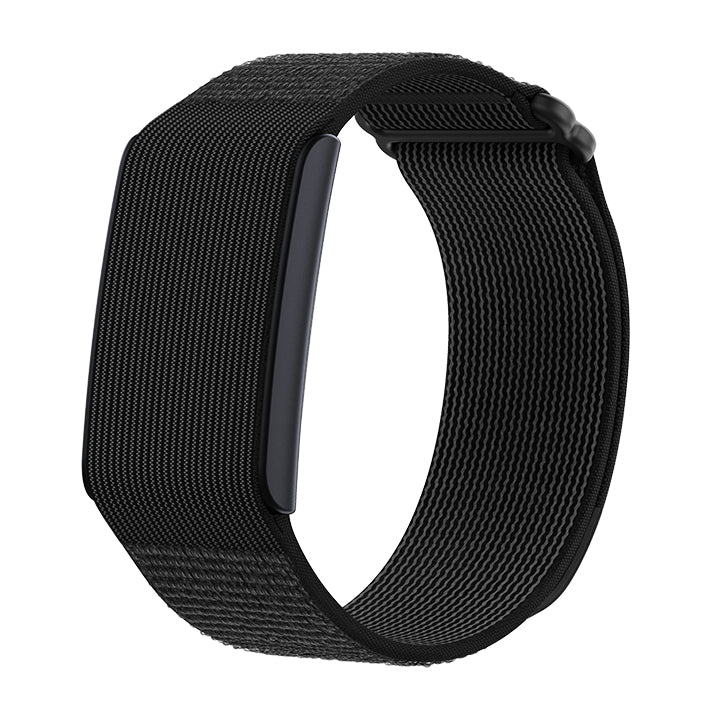
$99.99 is the whole transaction (reference price at the time of writing — check the live listing for what it's actually selling for today). For that, you get the Helio Core — the 20-gram sensor module — running Amazfit's BioTracker optical sensor, rated 5 ATM, threaded through a nylon hook-and-loop band officially supported on the wrist or the upper arm. Battery is rated up to 10 days, and charging is magnetic — Amazfit includes the charging head in the box but not a USB cable, so you're supplying that yourself.
Free, permanently, in the Zepp app: 24/7 heart rate, recovery and exertion scores, sleep staging, HRV, blood oxygen and training-load metrics — conceptually the same toolkit WHOOP built its subscription on. Where the Helio Strap gets specific is the gym: it tracks strength training with reps, sets and rest periods, and runs a dedicated HYROX Race mode that, as far as we can find, nothing else in this comparison offers — more on that below. It can also broadcast live heart rate to gym equipment and other apps, a trick usually reserved for chest straps. Full breakdown, including where it falls short: our Amazfit Helio Strap review.
There's no onboard GPS — outdoor routes borrow your phone's, same as WHOOP — and no ECG or heart-rhythm feature of any kind, on any version. We'll come back to that.
How Much Does WHOOP Cost? One vs Peak vs Life
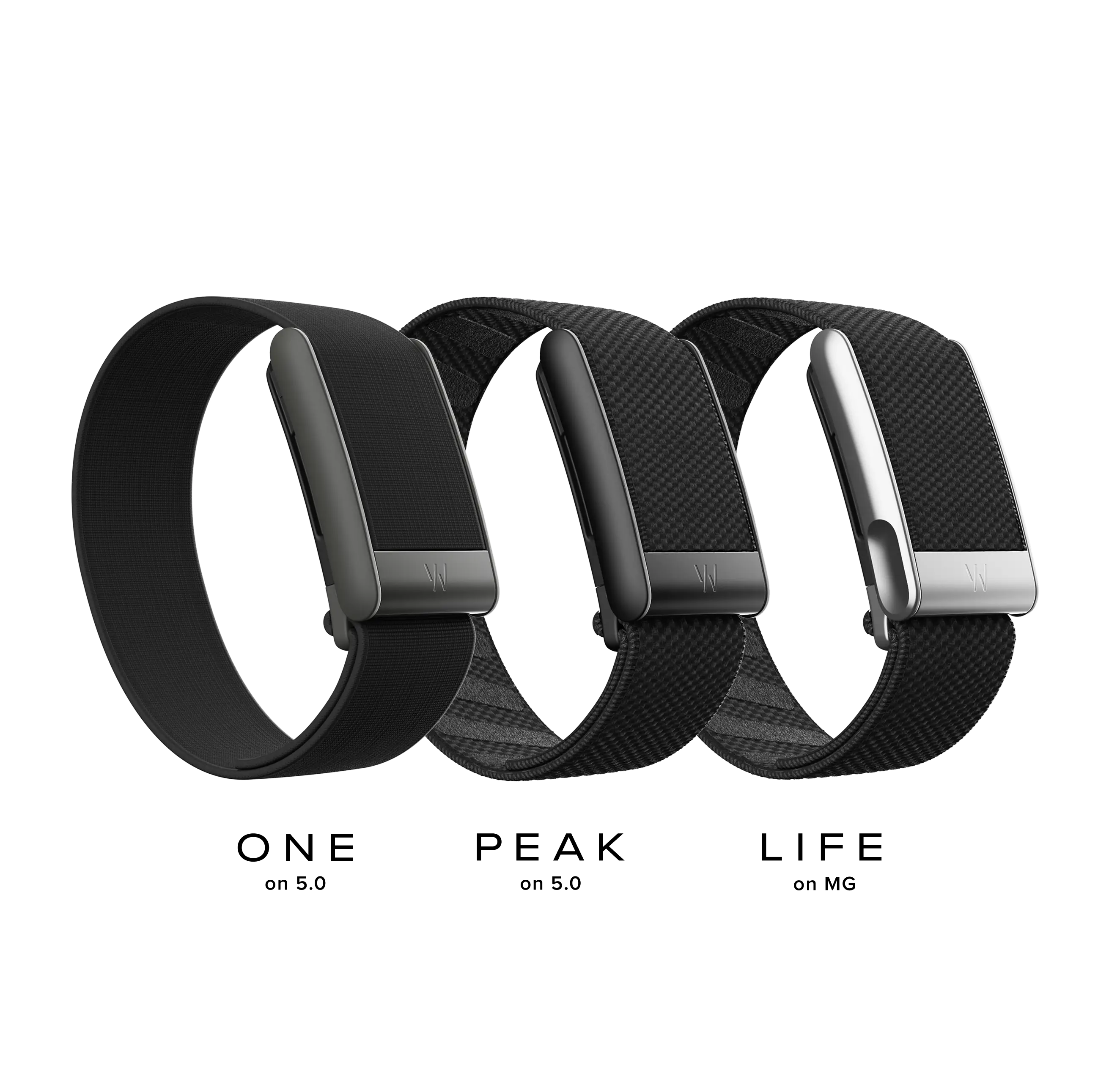
WHOOP doesn't have a single-number answer to this because there's no one-time purchase at all. Every plan bundles hardware with a required annual membership:
| Plan (2026)* | Hardware | Per year | What you get |
|---|---|---|---|
| WHOOP One | WHOOP 5.0 | ~$199 | Sleep, strain, recovery, VO2 max, hormonal insights — the core experience |
| WHOOP Peak | WHOOP 5.0 | ~$239 | + Healthspan (WHOOP Age, Pace of Aging), real-time health alerts, stress tracking |
| WHOOP Life | WHOOP MG | ~$359 | + On-demand ECG (Heart Screener), Blood Pressure Insights, Luxe band |
*Reference pricing at the time of writing; WHOOP sets membership rates and they can change — check whoop.com or the live Amazon listing. Full tier-by-tier breakdown: our WHOOP 5.0 vs WHOOP MG guide.
Under the hood, the 5.0 and MG share the same sensor platform and the same 14+ day battery — nearly 50% longer than the Helio Strap's 10. Both are IP68-rated, swim-safe to 10 meters for up to two hours, versus the Helio Strap's 5 ATM (showers and pool laps, not rated for open water). Neither WHOOP model has onboard GPS either — outdoor pace and route data need your phone's connected GPS, same limitation as the Helio Strap.
Amazfit Helio Strap vs WHOOP: What Do They Cost Over 3 Years?
This is the number that actually settles most of these purchases, so here it is with no rounding games:
| Cost over 3 years* | Amazfit Helio Strap | WHOOP One | WHOOP Peak | WHOOP Life (MG) |
|---|---|---|---|---|
| Hardware | $99.99 | Included | Included | Included |
| Required fees × 3 yrs | $0 | ~$597 (~$199/yr) | ~$717 (~$239/yr) | ~$1,077 (~$359/yr) |
| Total | ~$99.99 | ~$597 | ~$717 | ~$1,077 |
| What you own after | The tracker | Nothing that works | ||
*Reference pricing at the time of writing; WHOOP sets membership rates and they can change.
Call it $497 to $977 saved over three years by going with the Helio Strap instead of WHOOP — and that Helio Strap keeps working in year four, five and beyond at zero further cost, same as it did on day one. The honest counterargument is coming: WHOOP's coaching is genuinely more refined, and for the right person that's worth paying for every year. Just make the call knowing the real number.
Helio Strap vs WHOOP: Which Has Cheaper Replacement Bands?
Total cost of ownership isn't just the device and the membership — it's also what happens the first time a band wears out, and this is where the Helio Strap's advantage gets bigger than the sticker price suggests.
The Helio Strap uses a standard 22mm quick-release band — the same fitting as several Amazfit watches, including the Balance, Balance 2, T-Rex 3 and Bip 5/6. That means the entire aftermarket for those watches works on it too: third-party replacement bands start around $8, and a version that ships with its own frame case (so you can keep two setups permanently assembled) runs about $10 to $15. We mapped every option, including the "band only" catch that trips people up, in our Helio Strap bands guide.
WHOOP goes the opposite direction. Its bands are proprietary to WHOOP's own clasp system — and not even backward-compatible within WHOOP's own lineup: WHOOP's own support documentation confirms that 4.0-generation bands don't fit the 5.0 or MG at all, because the clasp housing was resized. Official replacement bands run about $49 for the SuperKnit up to $59 for the SportFlex, with premium Luxe/LeatherLuxe versions running $89 and beyond. The best-selling third-party alternative on Amazon undercuts that at around $20 — real savings, but still two-and-a-half times what a basic Helio Strap band costs, and if you own an MG and actually use its ECG, you're restricted to bands with the specific conductive clasp hardware, which narrows the cheap options considerably. We go deep on that exact trap in our WHOOP bands guide.
Neither company's straps last forever — sweat and hook-and-loop or knit are never a great long-term match — but only one of these two locks you into its own storefront, and its own generation, to replace one.
Does Either Have a Dedicated HYROX Mode?
Short answer: one of them does, and it's not WHOOP.
The Helio Strap ships with a dedicated HYROX Race mode alongside rep/set/rest tracking for standard strength training — a feature set built specifically for gym-first, competition-adjacent training, not just running or cycling. It's a genuinely unusual thing to find on a $99.99 tracker, and as far as we can tell, nothing else in this comparison — WHOOP included — offers a named, dedicated HYROX activity type.
WHOOP has plenty of HYROX-adjacent content — its blog and podcast cover training and recovery for the sport in real depth — but as of this writing, HYROX isn't one of WHOOP's built-in activity types. The WHOOP community forum has an open, unresolved request asking the company to add Hyrox as a trackable activity specifically so it gets its own strain, calorie and performance numbers instead of being logged under a broader category like Functional Fitness or CrossFit. That's a feature request, not a product announcement, so treat it as the current state rather than something guaranteed to stay true — but at the time of writing, if a dedicated HYROX mode specifically is what you're shopping for, the Helio Strap has one and WHOOP doesn't.
Amazfit Helio Strap vs WHOOP: Full Spec Comparison
| Feature | Amazfit Helio Strap | WHOOP 5.0 / MG |
|---|---|---|
| Price | $99.99, once | Bundled with membership — no one-time option |
| Subscription | None required | Required — ~$199–$359/yr |
| Battery | ~10 days | 14+ days |
| Charging | Magnetic head (no cable included) | 152 min (Basic) / 110 min (PowerPack) |
| Water rating | 5 ATM (pool-safe, not open water) | IP68, swim-safe to 10m for up to 2 hrs |
| Weight | ~20g (module) | 26.5g |
| Wear position | Wrist or upper arm (both official) | Wrist only |
| Onboard GPS | ❌ Connected GPS via phone | ❌ Connected GPS via phone |
| HR sensor | Amazfit BioTracker optical | WHOOP proprietary optical |
| HR broadcast to other devices | ✅ Live broadcast to gym gear & apps | ❌ Stays in the WHOOP app |
| Band system | ✅ Standard 22mm, aftermarket from ~$8 | Proprietary, ~$49–$89 official / ~$20 third-party |
| Strength / HYROX tracking | ✅ Reps, sets, rest + HYROX Race mode | ❌ No dedicated HYROX mode |
| ECG / AFib | ❌ None, any plan | ❌ 5.0: none · ✅ MG only (Life plan): FDA-cleared Heart Screener |
| App | Zepp | WHOOP |
| Screen | None | None |
Sources: Amazfit (Helio Strap specs), WHOOP/WHOOP Support (5.0/MG specs and band compatibility) — full list at the bottom.
Which Is More Accurate — Helio Strap or WHOOP?
We haven't lab-tested these two side by side ourselves, so this leans on DC Rainmaker's August 2026 accuracy deep-dive, which put the WHOOP 5.0, Amazfit Helio Strap, Garmin Cirqa, Fitbit Air and Polar Loop through weeks of workouts, sleep and step testing.
On automatic workout detection — arguably the most important category for a device you're not manually starting every time — the gap is real. DC Rainmaker rated WHOOP "excellent, with very rare/few errors," while the Helio Strap was "really good at detecting elevated HR, but can't detect workout types and often prematurely ends things" — it will split a single session into two entries if you slow down for as little as 90 seconds, which is exactly what happens between HYROX stations or during rest periods on a lifting day. On steps, the Helio Strap actually nailed a 500-step test almost exactly (505 recorded) — but on active days it converts non-step workouts like cycling into an estimated step count of its own, which inflates daily totals versus what you actually did. On HRV, DC Rainmaker's testing found Amazfit's readings run toward the higher end of the group compared to the other devices tested, WHOOP included.
Translation: for resting heart rate and sleep, both are solid. If your training involves a lot of stop-start work — HYROX stations, circuit rest periods, supersets — WHOOP's detection is the more dependable of the two today, even though the Helio Strap is the one built with that exact training style in mind on paper.
Does Either the Helio Strap or WHOOP Detect AFib?
Only one of these two products, on one specific plan, and it's worth being exact about which.
The Amazfit Helio Strap has no ECG or heart-rhythm feature of any kind. It's not a paywalled add-on you can unlock — the hardware simply doesn't include the electrodes needed to take one, on any Amazfit plan or app tier.
The WHOOP MG — the hardware bundled specifically with the Life plan — has a real, FDA-cleared on-demand ECG called Heart Screener. Pinch the MG's conductive metal clasp for about 30 seconds and it records a genuine single-lead ECG, cleared by the FDA (510(k) K243236, decided April 4, 2025) after a roughly 540-subject validation trial that found 96.2% sensitivity and 99.4% specificity for classifying atrial fibrillation. The base WHOOP 5.0 — One and Peak plans — gets none of this; no electrodes, no ECG, the feature is tied specifically to the MG's clasp hardware.
So if heart-rhythm screening is a real reason you're shopping, this comparison only has one device that offers it at all, and it costs ~$359 a year to access. Our heart health and AFib guide covers how that stacks up against every other screen-free device we've reviewed, including an Apple Watch.
Where WHOOP Still Wins
Being straight about this matters more than winning the argument for either side.
Recovery and strain coaching. WHOOP doesn't just show you numbers, it tells you what to do with them — a morning recovery percentage, strain targets that stop you from junk-training into a hole, sleep coaching that actually nudges your bedtime. The Helio Strap gives you recovery and exertion scores that cover the same conceptual ground, but WHOOP's behavioral layer on top of similar data is still the most refined in the category, and it's the entire reason people keep paying for it.
The MG's real ECG. Covered above, and it's not a small thing — nothing else in this comparison offers anything like it.
Longer battery. 14+ days versus the Helio Strap's 10. Not decisive by itself, but it's fewer charges across a year.
A more mature app. WHOOP's app has had a decade to sand down its rough edges. The Zepp app holds the same categories of data and has improved fast, but it's still a step behind WHOOP's polish and Garmin Connect's simplicity — busier layout, occasional translation quirks. The data's there; the storytelling around it is thinner.
Automatic workout detection. Per DC Rainmaker's testing above, WHOOP's detection is meaningfully more dependable during stop-start training than the Helio Strap's.
Where the Helio Strap Wins
Cost — specifically the shape of it. $99.99 once beats $199–$359 every year almost regardless of how you value WHOOP's coaching, unless you're certain you'll renew for years and years.
The band ecosystem. Standard 22mm bands from ~$8 versus WHOOP's proprietary ~$49–$89 official straps (or ~$20 for the best third-party option) — and WHOOP won't even let its own previous-generation bands cross over. Covered in full above.
A dedicated HYROX mode. WHOOP has none as of this writing; the Helio Strap has had one since launch.
Heart-rate broadcasting. The Helio Strap can send live heart rate to gym equipment and other fitness apps — a trick usually reserved for chest straps. WHOOP keeps its data inside its own app and ecosystem.
Upper-arm wear, officially. Both can technically be worn off-wrist, but Amazfit documents and sells for it directly, sidestepping the wrist flexion and grip tension that mess with optical sensors mid-lift.
Amazfit Helio Strap vs WHOOP: Pros and Cons
Amazfit Helio Strap
- ✓ $99.99 once — no subscription, ever
- ✓ Standard 22mm bands from ~$8, not locked to one brand's storefront
- ✓ Dedicated HYROX Race mode + rep/set/rest tracking
- ✓ Broadcasts live heart rate to gym equipment and apps
- ✓ Wrist or officially-supported upper-arm wear
- ✕ No ECG or heart-rhythm feature of any kind
- ✕ Weaker automatic workout detection than WHOOP, per DC Rainmaker
- ✕ Zepp app less polished than WHOOP's or Garmin Connect's
- ✕ 10-day battery vs WHOOP's 14+; stock has been erratic since launch
WHOOP 5.0 / MG
- ✓ Best-in-class recovery and strain coaching
- ✓ MG's real, FDA-cleared on-demand ECG (Life plan)
- ✓ 14+ day battery and the more dependable auto-detection
- ✓ Mature app athletes already trust
- ✕ ~$199–$359 every year, forever — no one-time purchase exists
- ✕ Band goes completely dark if the membership lapses
- ✕ Proprietary bands (~$49–$89 official) that don't even carry over between WHOOP's own generations
- ✕ No dedicated HYROX mode; no heart-rate broadcasting to third-party devices
Who Should Buy the Helio Strap — and Who Should Buy WHOOP?
Buy the Amazfit Helio Strap if you…
- Refuse to pay a recurring fee for hardware you already bought
- Lift, do CrossFit or HYROX, and want a mode built for exactly that
- Want the freedom to buy an ~$8 replacement band instead of being tied to one company's straps
- Are leaving WHOOP specifically over cost, not over the coaching itself
Buy WHOOP if you…
- Will genuinely read and act on a morning recovery score and strain target daily
- Specifically want the MG's on-demand ECG (Life plan only)
- Train with a lot of stop-start intervals and value best-in-class automatic detection over saving money
- Have done the 3-year math and decided the coaching is worth it — a legitimate call, if you make it with open eyes
Neither Sounds Right? A Few More Doors
- Want the WHOOP comparison for a different budget band instead? → Fitbit Air vs WHOOP 5.0 puts Google's $99 band up against WHOOP directly.
- Want Garmin's full training stack instead of a gym-first band? → Garmin Cirqa vs WHOOP.
- Deciding between the Helio Strap and Google's band specifically? → Fitbit Air vs Amazfit Helio Strap.
- Already committed to leaving WHOOP and want every option, not just this one? → Best WHOOP Alternatives Without a Subscription.
Amazfit Helio Strap or WHOOP? Bottom Line
The Amazfit Helio Strap costs ~$99.99 once. WHOOP costs ~$199 to $359 every single year and goes dark the day you stop paying. For most people reading this — especially anyone who typed "WHOOP alternative" into a search bar right after a renewal notice landed — that math alone settles it, and the Helio Strap is the most literal WHOOP-shaped answer on this entire site: same wrist, same 24/7 job, a fraction of the bill, and bands you're not locked into buying from one company forever.
WHOOP survives this comparison in the same lane it always does: people who'll actually use the coaching daily, competitive athletes doing a lot of stop-start training where its detection edge matters, and the smaller group who specifically need the MG's real ECG. If that's you, the subscription isn't a rip-off — it's the price of features that genuinely don't exist on the Helio Strap. Everyone else is paying every year for recovery scores a $99.99 band also produces, on bands that cost a fraction as much to replace. See how both fit into the wider field on the 2026 screenless tracker shortlist.
Amazfit Helio Strap vs WHOOP FAQ
Does the Amazfit Helio Strap need a subscription to compete with WHOOP?
No. Every feature — recovery, strain, sleep, strength tracking, HYROX mode — is free forever in the Zepp app. That's its entire pitch against WHOOP's required membership.
How much does WHOOP cost compared to the Amazfit Helio Strap?
The Helio Strap is $99.99 once, and that's the whole bill. WHOOP has no one-time option: One runs about $199/year, Peak about $239/year, and Life (the only tier with the MG's ECG) about $359/year — every year, for as long as you want the band to keep working. Over three years that's roughly $597 to $1,077 for WHOOP against $99.99 total for the Helio Strap.
Is the Amazfit Helio Strap or WHOOP more accurate?
They're close on resting heart rate and sleep. DC Rainmaker's 2026 testing rated WHOOP's automatic workout detection "excellent, with very rare/few errors," while the Helio Strap detects elevated heart rate well but often misreads workout type and can split one session into two after a short pause — worth knowing if your training involves a lot of stop-start work.
Does the Amazfit Helio Strap or WHOOP have a dedicated HYROX mode?
The Helio Strap does — a built-in HYROX Race mode alongside rep, set and rest tracking. As of this writing, WHOOP has no dedicated HYROX activity type; adding one remains an open request on WHOOP's own community forum.
Does either the Helio Strap or WHOOP detect AFib?
Only WHOOP, and only on one plan. The WHOOP MG (Life plan) has an FDA-cleared on-demand ECG called Heart Screener. The base WHOOP 5.0 (One and Peak) has no ECG, and the Amazfit Helio Strap has no heart-rhythm feature of any kind on any plan.
Which has cheaper replacement bands, the Helio Strap or WHOOP?
The Helio Strap by a wide margin. It uses a standard 22mm quick-release fitting, so third-party bands start around $8. WHOOP's bands are proprietary — officially $49 to $89 — with a best-selling third-party alternative around $20, and WHOOP's own 4.0-generation bands don't even fit the 5.0 or MG.
Amazfit Helio Strap or WHOOP — which should I buy?
Buy the Helio Strap if you want WHOOP-style 24/7 tracking with zero ongoing bill and a HYROX mode built in — it's the better deal for most people, especially anyone leaving WHOOP over cost. Buy WHOOP if you'll actually use its deeper recovery coaching daily, train with a lot of stop-start intervals, or specifically need the MG's real ECG.
Sources
- DC Rainmaker — Accuracy deep-dive: Helio Strap vs WHOOP 5.0 auto-detection, HRV and step-count findings.
- the5krunner — Amazfit Helio Strap hands-on review: independent assessment of the Helio Strap as a WHOOP competitor.
- Amazfit — Helio Strap product page (US): 22mm band width, 5 ATM rating, 10-day battery, HYROX Race mode, in-box contents.
- WHOOP — Membership options: One/Peak/Life tier pricing and included hardware.
- WHOOP — Heart Screener: MG ECG feature description and Life-plan requirement.
- FDA 510(k) database via Innolitics — WHOOP ECG (electrocardiogram) Feature (1.0), K243236: Class II clearance, decision date, validation trial sensitivity/specificity.
- WHOOP Support — Band & Accessory Compatibility: 4.0-to-5.0/MG band incompatibility, official band materials and pricing.
- WHOOP Community — "Add Hyrox as Activity": open feature request confirming no native HYROX activity type as of this writing.