Best Smart Kitchen Scales for Calorie Tracking (And How They Pair With Your Tracker's Daily Goals)
Quick answer: Of the three scales here, only one names Fitbit as a direct sync target: the Etekcity 22lb Food Nutrition Scale (~$31), which connects through the free VeSync app to both Apple Health and Fitbit, per Etekcity's own listing. The RENPHO Smart Food Scale (~$21) is the budget pick — same core idea, but its app only confirms syncing to Apple Health, not Fitbit directly. The Greater Goods Food Scale (~$35) is the outlier: it has 2,000 foods built into the scale's own display and connects to nothing at all — no app required, and nothing reaches your tracker automatically. None of the three syncs directly into Garmin Connect or the Oura app, as far as we could verify.
Your tracker is good at one half of "calories in, calories out." WHOOP's Strain, Garmin's Training Readiness, Fitbit's activity ring — all of it is measuring the "out" side, the energy you burn. The "in" side, what you actually ate, still has to come from somewhere, and on every tracker we've used, that somewhere is either a manual food log or an educated guess at portion size. A kitchen scale doesn't fix the guessing part of your day — it just replaces "that's probably about a cup" with an actual number, which is the input your tracker's calorie math was built to use in the first place.
We already covered the other two legs of this: a cordless blender and two personal blenders for getting protein in (our kitchen gear guide), and which water bottles actually push hydration data anywhere (our smart water bottle guide). This one is about the third leg — portion size and calories — and specifically about which of these scales' "smart" claims hold up when you check what they actually connect to.
- Best synced to Fitbit: Etekcity 22lb Food Nutrition Scale (~$31) — connects to both Fitbit and Apple Health via VeSync, per Etekcity's own listing
- Best budget pick: RENPHO Smart Food Scale (~$21) — same core function, confirmed Apple Health sync, no confirmed Fitbit connection
- Best if you don't want another app: Greater Goods Food Scale (~$35) — 2,000 foods built into the display, zero Bluetooth, zero sync
1. Etekcity 22lb Food Nutrition Scale — The Only One That Names Fitbit
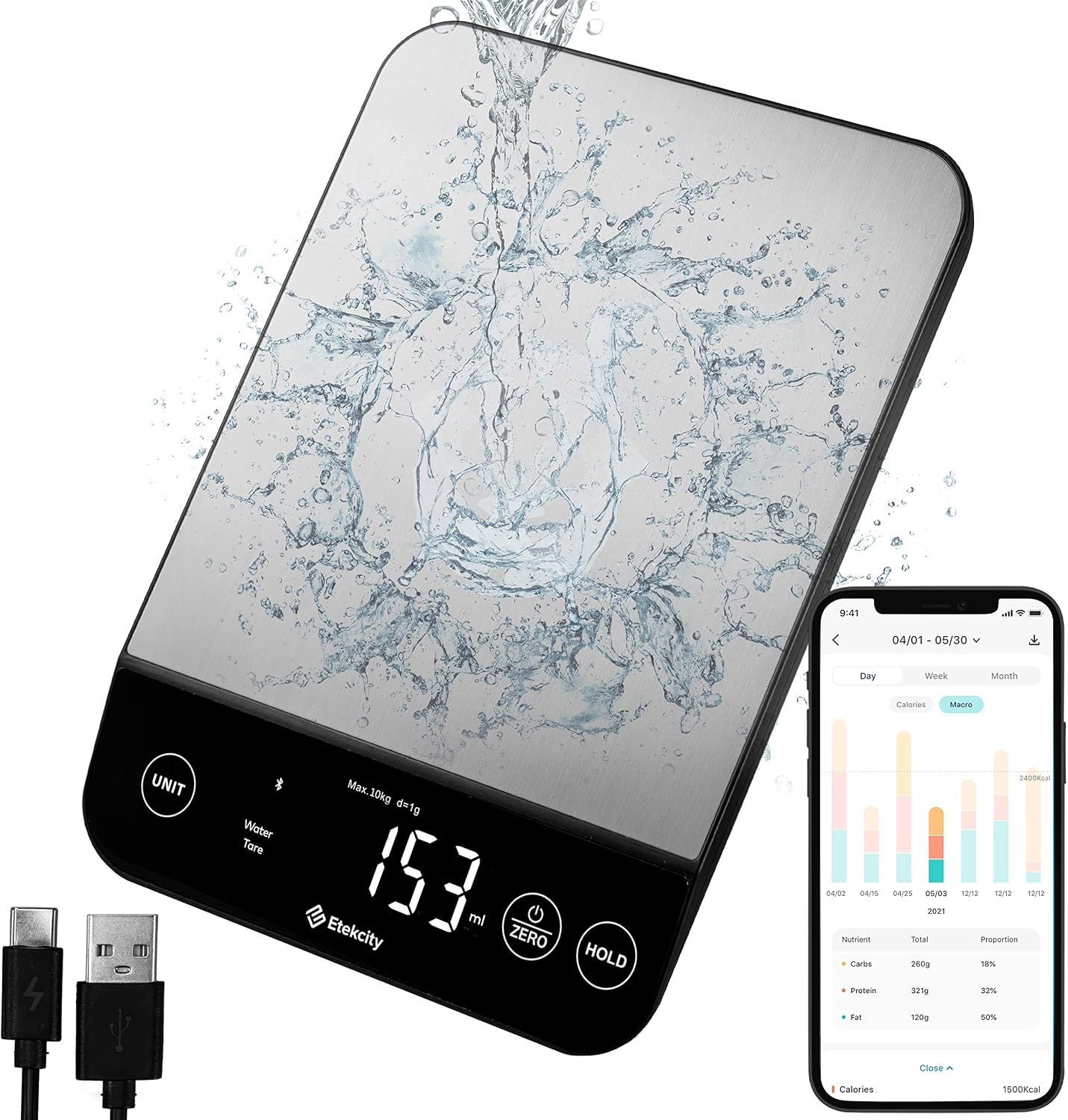
Around $31 (September 2026) · 2g–22lb range · syncs to VeSync app
This is the pick if you're on Fitbit and want your weighed food to reach it without retyping anything. Per Etekcity's own listing, the scale connects to the free VeSync app and, from there, syncs directly to Apple Health and Fitbit. We can't tell you exactly how that data displays once it lands on Fitbit's side — Fitbit's own help documentation on food logging now lives under Google's support site rather than a dedicated Fitbit page, and describes logging food against calories burned inside the Google Health app, not a standalone Fitbit "Food Log." What Etekcity's listing does confirm is the connection itself. It logs 19 nutrition facts per item, and you can scan a barcode or search a food database instead of typing every ingredient in by hand.
The honest limit: the listing names Apple Health and Fitbit specifically, and nothing else. There's no mention of a direct Garmin Connect or Oura connection, so if that's your tracker, you're checking totals in VeSync or Apple Health rather than seeing food data natively inside Garmin's or Oura's own app. For Fitbit and Apple Watch households specifically, though, this is the one scale in this guide that actually closes the loop.
2. RENPHO Smart Food Scale with Nutritional Calculator — Budget Pick, Apple Health Only
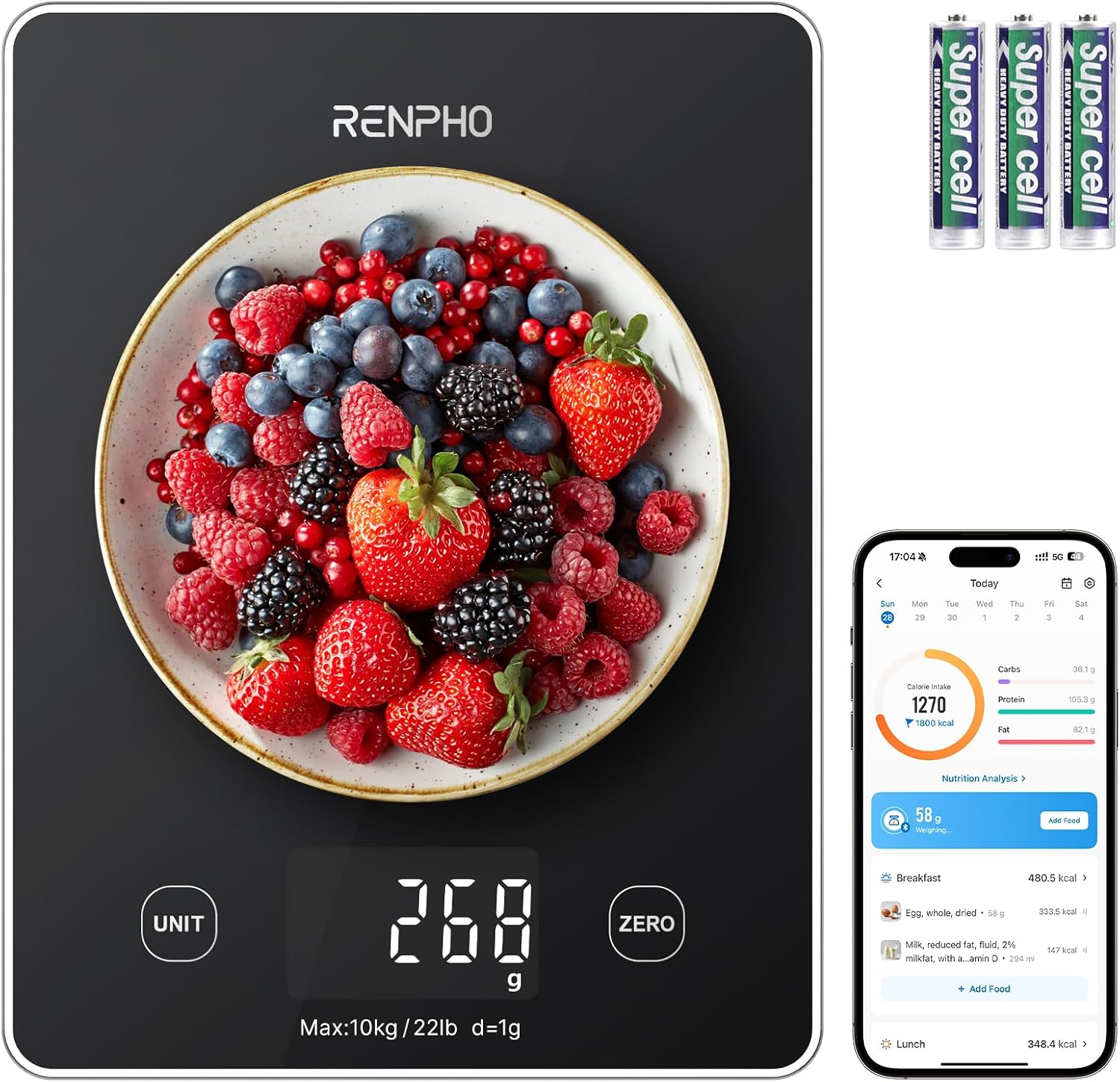
Around $21 (September 2026) · 1g–10kg range · syncs to Renpho Health app
This is the cheaper way into the same basic idea. Per the listing, the RENPHO connects to the Renpho Health app, which carries an extensive USDA food database and — per RENPHO's own Apple Health setup guide — can push nutrition data to Apple Health once you authorize it. It also doubles as a coffee scale, with a bean-to-water ratio timer built into the app, and it weighs down to 1g across five unit options. Four sensors and a one-touch tare function make it functionally similar to the pricier scale.
What we couldn't confirm: a direct Fitbit connection. Renpho's own materials describe Apple Health and Google Fit syncing, but unlike Etekcity's listing, nothing we found names Fitbit specifically as a supported integration. If you're on an iPhone and don't use Fitbit, that's a non-issue. If Fitbit is specifically the app you want your scale to reach, this isn't the confirmed way to get there — the Etekcity is.
3. Greater Goods Food Scale, 2,000 Built-In Codes — The One That Skips the App Entirely
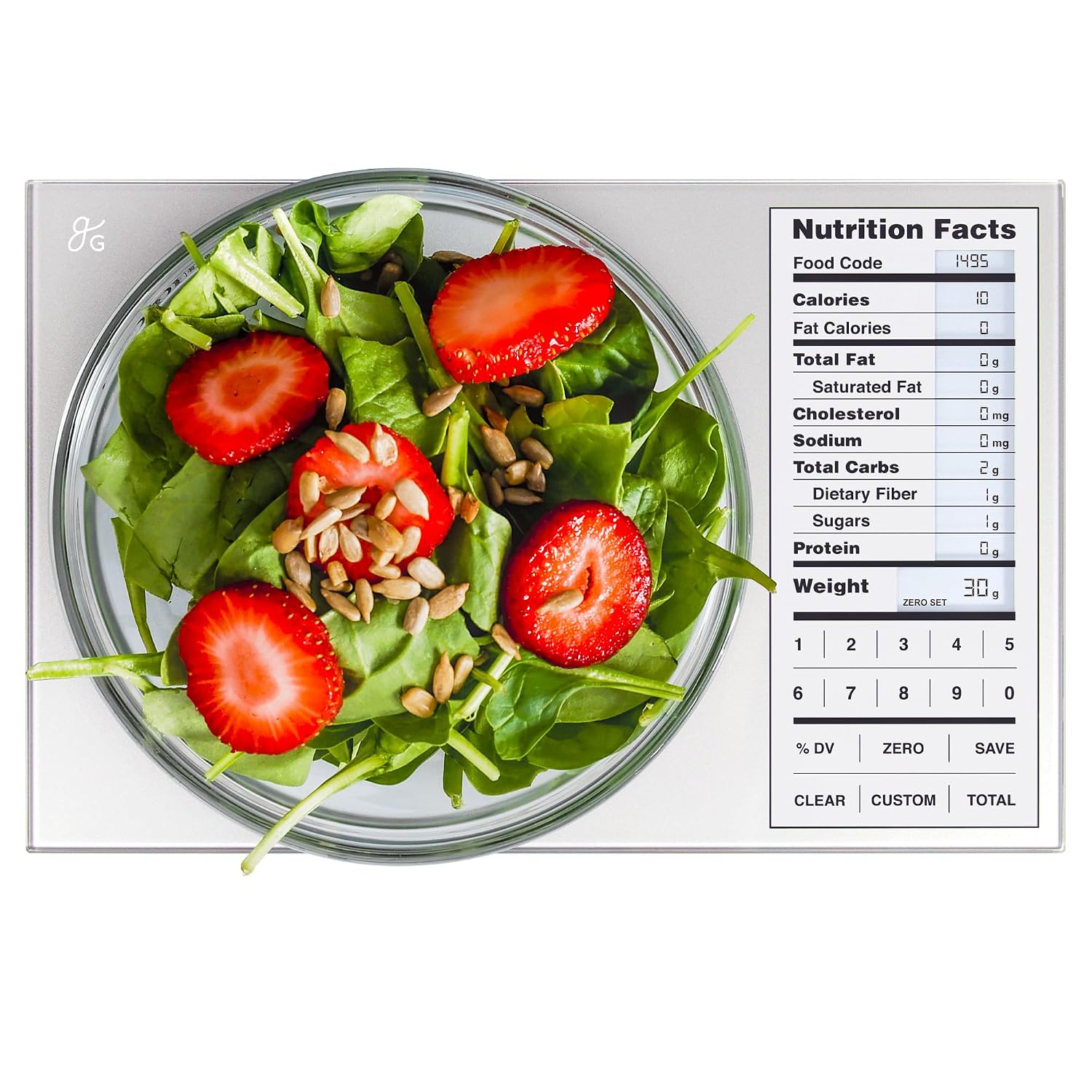
Around $35 (September 2026) · 11lb capacity · no app or Bluetooth required
This one is here on purpose, not as a compromise. Per the product listing, it's explicitly marketed "No App Required": 2,000 common foods are coded directly into the scale, you punch in a code from the included booklet, and the backlit display shows calories, protein, carbs, fat and sodium right there — no account, no Bluetooth pairing, no phone needed. There's an optional companion app if you'd rather look up codes on your phone than flip through the booklet, but it's a reference tool, not a sync path.
The trade-off is the obvious one: nothing here reaches Fitbit, Apple Health, or any tracker automatically. If you want that number in your tracker's daily total, you're copying it over yourself. For anyone who specifically doesn't want another app talking to their phone, or who's tracking manually in a notebook or a tracker's own log, that's a feature rather than a missing one — and it's also the most private option of the three, since nothing about what you eat leaves the counter.
The 3 Kitchen Scales Side by Side
| Product | Price (Sept 2026)* | Confirmed sync | Best for |
|---|---|---|---|
| Etekcity 22lb Food Nutrition Scale | ~$31 | Fitbit + Apple Health (via VeSync) | Fitbit households |
| RENPHO Smart Food Scale | ~$21 | Apple Health (via Renpho Health) | iPhone users, budget |
| Greater Goods Food Scale | ~$35 | None — no app or Bluetooth | Manual tracking, no extra apps |
*Reference prices at the time of writing; Amazon's price at checkout governs.
How Does a Kitchen Scale Actually Pair With Your Fitbit, Garmin, Oura or WHOOP Daily Goal?
"Syncs with your tracker" turns out to mean something narrower than it sounds, and it's worth being upfront about what we could and couldn't verify. Fitbit is now part of Google, and Fitbit's own consumer help page on food tracking no longer exists as a standalone Fitbit article — it redirects to Google's support site, retitled "Track your nutrition and hydration with the Google Health app." That current documentation confirms the basic idea: you log food throughout the day and the app checks your "estimated calories eaten against calories burned," and on the data side, "the Google Health app will seamlessly pull that data in using Health Connect (Android) or Apple Health (iOS)." Etekcity's own listing says its scale connects to both Apple Health and Fitbit through VeSync — so the realistic path, especially on iPhone, is that weighed food reaches Apple Health and from there is available to whatever app (Google Health included) pulls from it. We could not independently confirm the exact mechanics of VeSync's direct-to-Fitbit connection beyond what Etekcity's own listing states, since a dedicated Fitbit-branded explanation of that pathway no longer appears to exist.
RENPHO's path is shorter and narrower. Its Renpho Health app syncs nutrition data to Apple Health, which is a genuinely useful destination if you're on an iPhone — plenty of tracker apps, including some smart ring companion apps, can display an Apple Health widget — but it's Apple Health doing that work, not a direct RENPHO-to-Fitbit or RENPHO-to-Garmin connection. And for Garmin Connect or the Oura app specifically, we couldn't find either brand's integrations list naming a food scale, kitchen scale, or nutrition app of any kind. That tracks with what we found when we checked smart water bottles against the same two apps: Garmin Connect and Oura are built as dashboards for their own hardware's sensors, not as import points for arbitrary third-party health data.
The Greater Goods scale isn't trying to pair with anything, which is really the fourth honest answer here: some people would rather see the label on the scale, do their own math, and type one number into their tracker's food log themselves. All three approaches get you a real number instead of a guess — they just hand it to you in different places.
Does Weighing Your Food Actually Beat Guessing Portions? What the Research Says
Somewhat — though the real numbers are more modest than the dramatic claims you'll see elsewhere. A 2021 study in the Journal of Human Nutrition and Dietetics tested two non-scale ways of estimating portion size against 40 people's actual weighed intake: describing a portion in words, versus judging it from a photo. Written descriptions came out ahead (a 0% median relative error, versus 6% for photo-based guesses), but even that stronger method landed within 10% of the true weight only 31% of the time, and within 25% just half the time; photo-based estimates did worse on both measures — 13% and 35%. Put plainly: even a careful written guess at a portion misses the true weight by more than 10% roughly two times out of three.
Weighing food doesn't make tracking perfect, either — that's worth saying plainly rather than overselling these scales. A separate, frequently cited analysis by Schoeller (published in Nutrition Reviews, 1990) found that even people keeping weighed food records tend to underreport their true energy intake over time, once compared against objective measures of energy expenditure. The honest takeaway from both studies: a scale won't guarantee your calorie log is exactly right, but it removes a real, measurable source of error — the gap between what a portion looks like and what it actually weighs.
Best Smart Kitchen Scales for Calorie Tracking FAQ
Does a smart kitchen scale sync directly with my Fitbit calorie goal?
Etekcity's own listing is the only one of the three that names Fitbit directly: the scale connects to the free VeSync app, which it says syncs to both Apple Health and Fitbit. We can't confirm exactly how that data displays once it lands, though - Fitbit's own consumer help documentation on food logging has been folded into Google's support site (Fitbit is now part of Google), and the current page describes logging food against calories burned inside the Google Health app rather than a separate Fitbit 'Food Log.' The RENPHO scale in this guide only confirms syncing to Apple Health, not Fitbit directly, and the Greater Goods scale doesn't sync to anything.
Can I use a smart kitchen scale with Garmin Connect or the Oura app?
Not directly, based on what we could verify. Neither Etekcity's VeSync app nor RENPHO's Renpho Health app lists Garmin Connect or the Oura app among their integrations - both name Apple Health (and in Etekcity's case, Fitbit) instead. If you're on iPhone, weighed food still lands in Apple Health, where it sits next to whatever your Garmin or Oura device separately writes there - you just won't see it inside Garmin Connect's or Oura's own interface. This is the same gap we found when we checked smart water bottles against the same two ecosystems.
How much more accurate is weighing food versus eyeballing portions?
Somewhat, though the real research is more modest than headlines suggest. A 2021 study in the Journal of Human Nutrition and Dietetics compared two non-scale ways of estimating portion size - describing a portion in words versus judging it from a photo - against 40 people's actual weighed intake. Written descriptions were the more accurate of the two (a 0% median relative error, versus 6% for photo-based estimates), but even that stronger method landed within 10% of the true weight only 31% of the time, and within 25% just half the time; photo-based estimates did worse on both counts (13% and 35%). Separately, a classic analysis by Schoeller (Nutrition Reviews, 1990) found that even people keeping weighed food records tend to underreport their true energy intake over time. Neither finding proves a scale makes your log perfect - it just removes the guesswork on the one variable a scale can actually control: how much food is really on the plate.
Is the $21 RENPHO scale good enough, or should I pay more for the Etekcity?
It depends on which tracker you use. Both scales weigh in 1g increments and both have an app with a food database. The real difference is where your data goes: Etekcity's VeSync app pushes to Fitbit and Apple Health; RENPHO's Renpho Health app only confirms Apple Health. If you're on Fitbit and want your food log to land there automatically, the Etekcity is worth the extra roughly $10. If you're on an iPhone without Fitbit, or you mainly want the scale itself and don't care which app it lives in, the RENPHO does the same core job for less.
What if I don't want another app on my phone at all?
That's exactly what the Greater Goods scale is built for. Per its own product listing, it ships with 2,000 foods built into the scale's own display - no account, no Bluetooth pairing, no app required to see calories, protein, carbs, fat and sodium for common foods. A companion app exists only as an optional code lookup reference. You won't get anything pushed into Fitbit, Apple Health or any tracker automatically - you'd type your own totals into whatever tracker app you use, by hand - but if the goal is fewer apps rather than more integration, this is the more private way to do it.
Sources
- Etekcity — Smart Nutrition Scale ESN00 official product page: VeSync/Apple Health/Fitbit sync and 19-nutrient tracking.
- Google Health Help Center — Track your nutrition and hydration with the Google Health app: current documentation on how Fitbit's nutrition tracking works now that it's part of Google Health.
- RENPHO — Apple Health Kit Setting Guide: confirms the Renpho Health app's Apple Health sync.
- Greater Goods — Nourish Digital Kitchen Food Scale (Not-Connected) product page: confirms no-app, built-in food code design.
- Lucassen et al., "The accuracy of portion size estimation using food images and textual descriptions of portion sizes", Journal of Human Nutrition and Dietetics, 2021 — text-based vs. image-based portion-estimation accuracy.
- Schoeller DA, "How accurate is self-reported dietary energy intake?" — Nutrition Reviews, 1990;48(10):373-9, on underreporting even with weighed food records.