The Kitchen Gear Behind a Real Caffeine-Cutoff Routine — For When Your Sleep Score Blames Last Night's Coffee
Quick answer: Both WHOOP and Oura let you log when you had caffeine and compare it against your Recovery or Sleep Score the next day — that's a real, built-in feature, not a guess. Per WHOOP's own Journal data, caffeine within four hours of bed correlates with a 2 bpm higher resting heart rate, a 6ms lower HRV and roughly 7.5% lower Recovery; Oura's caffeine tag works similarly through its Trends view. No kettle or coffee maker can enforce a cutoff for you, but the right one removes the friction that leads to an unplanned extra cup: a programmable coffee maker with auto-shutoff (Hamilton Beach 46280J, ~$40, in stock) keeps your one morning pot from turning into an all-day hot plate, a temperature-controlled kettle (Cosori Gooseneck, ~$50–70, in stock) makes a fast, correctly-brewed decaf or herbal tea a realistic 3 p.m. swap, and a WiFi-scheduled machine (Café Specialty Grind & Brew, ~$320+, low stock) ties that single scheduled brew into a smart-home routine you already have.
- 4 hours — the caffeine-before-bed window WHOOP's own Journal data ties to a measurably worse Recovery.
- 7.5% lower Recovery, 2 bpm higher RHR, 6ms lower HRV — WHOOP's reported effect of caffeine within that window.
- 100+ — built-in behavior tags in the Oura app, including a dedicated caffeine tag.
- $40–$320+ — the price range of the three kitchen picks below, all confirmed in stock at the time of writing.
Why Does Your Sleep Score Keep Blaming Last Night's Coffee? (What WHOOP and Oura Actually Track)
This isn't a vibe or a marketing line — both platforms built real tooling around it. The WHOOP Journal lets members log well over 100 daily behaviors and tags, caffeine among them, then compares nights you said "yes" against nights you said "no" and shows how that lines up with resting heart rate, HRV, Recovery, sleep efficiency, respiratory rate and sleep consistency. It's not a one-night verdict, either: per independent coverage of the feature, WHOOP looks for at least five logged instances of a given behavior before it'll surface a personalized insight, which is closer to a small self-run experiment than a gut feeling.
The headline number comes straight from WHOOP's own analysis of that Journal data: consuming caffeine within four hours of bed was associated with a resting heart rate that rose by 2 beats per minute, an HRV drop of 6 milliseconds, roughly 7.5% lower Recovery, and almost a 1% drop in sleep efficiency. WHOOP is upfront that this is a correlation pulled from aggregate member data and individual responses vary — some people metabolize caffeine fast enough that a 6 p.m. espresso barely registers, others see it in a 2 p.m. coffee. That's also not the whole caffeine story on WHOOP's own platform: a WHOOP social post from its data team once noted that 2–4 servings of caffeine, in aggregate, actually correlated with a Recovery boost — the point was never "caffeine bad," it was "timing near bedtime is the specific variable that hurts." Independent coverage from the5krunner, tracking WHOOP's Recovery Behaviours feature since it expanded, separately confirms caffeine has been one of the platform's trackable, Recovery-linked behaviors for years now.
Oura runs a lighter-touch version of the same idea. Per Oura's own support documentation, the app ships with a built-in caffeine tag among more than 100 searchable options (alongside things like alcohol, late meal, and stress), and Oura is explicit that tags don't directly change your Sleep or Readiness Score — you log the tag, then pull up the Trends view and overlay it against your Sleep Score to look for your own pattern. Oura's own blog highlights a real member story to make the point: a user named Dan discovered through his own tagging that late afternoon coffee was quietly cutting into his overall sleep quality, something he hadn't connected until he saw the tag lined up against the dip. Independent reviewers of the feature recommend tagging caffeine the moment you drink it rather than reconstructing it the next morning, since same-day tagging produces cleaner data for spotting the pattern. See our WHOOP Recovery Score guide for what else moves that number, or our low Sleep Score buying guide if coffee isn't the only suspect.
No, a Kettle Won't "Cut You Off" — Here's What Kitchen Gear Can Actually Change
Let's be straight about what's being sold here, because it's easy to overclaim in this exact spot. A coffee maker cannot stop you from grinding more beans at 3 p.m. A kettle cannot enforce a bedtime rule. Nothing in this guide "cuts you off" from caffeine — that decision is still yours, and per WHOOP's own data it's genuinely personal, not a number you can borrow from a stranger's Journal insight.
What kitchen gear actually changes is friction, and friction is most of what wrecks a cutoff routine in practice. A programmable coffee maker with a real auto-shutoff means your one deliberate morning pot doesn't sit on a hot plate at 2 p.m. quietly inviting a refill — once it shuts off, making more coffee is a deliberate choice again, not a five-second reach for an already-hot carafe. A gooseneck kettle with accurate temperature presets makes brewing a proper cup of decaf or herbal tea at 3 p.m. take about as long as pouring more coffee would have, which matters because the honest reason people skip the "healthier" swap isn't willpower, it's that it's more annoying than the bad option. And it's worth being precise here too: per Mayo Clinic, decaf coffee isn't caffeine-free — it typically still carries a few milligrams per cup, just far less than a regular cup — so decaf is a real reduction, not a total reset, and herbal tea (not green or black, which both still have real caffeine) is the actual zero option if that's the goal.
3 Kitchen Picks That Make a One-Brew Routine Easier to Keep
We picked one product per price tier, all verified in stock at the time of writing, each solving a different piece of the same friction problem.
Budget Pick: Hamilton Beach 12 Cup Programmable Coffee Maker (46280J) — ~$40
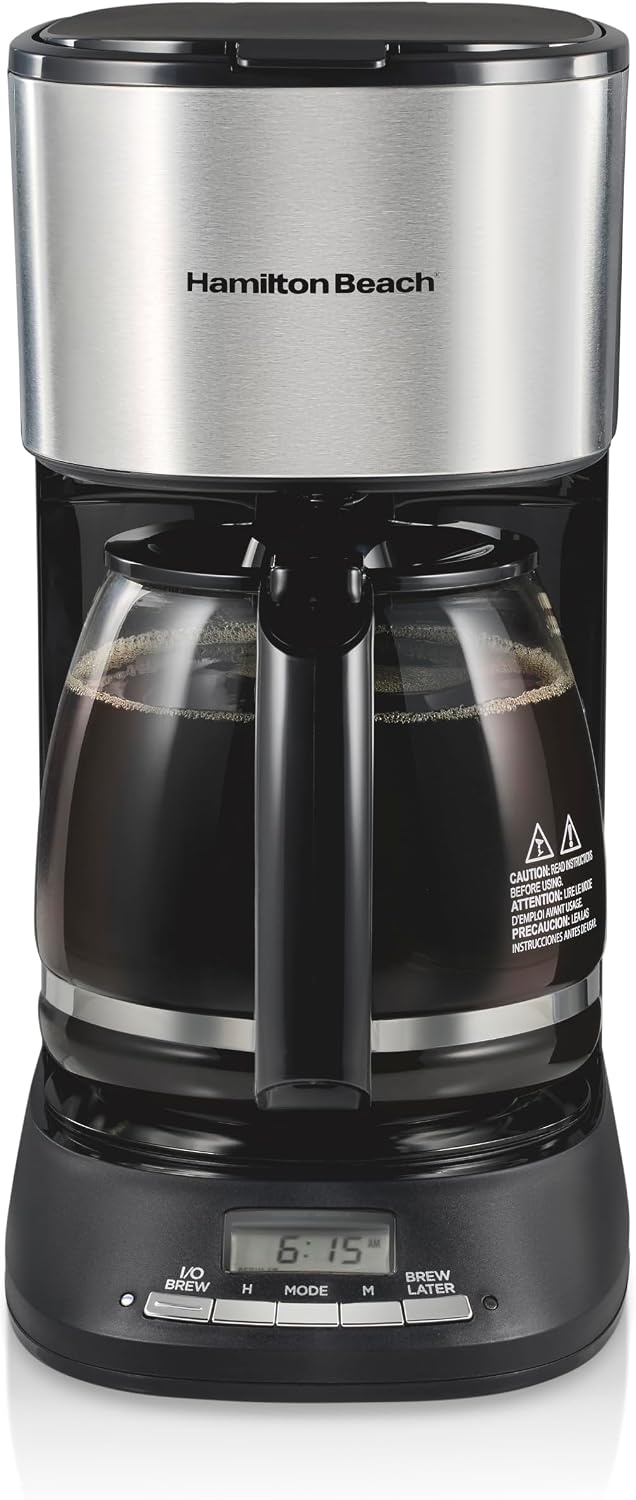
This is the cheapest way to make "one scheduled morning pot" the default instead of "coffee whenever I feel like it." Per Hamilton Beach's own listing, it programs up to 24 hours ahead and automatically shuts off after keeping coffee warm for 4 hours — so a pot brewed at 6 a.m. is off the hot plate by 10 a.m., not still sitting there warm and tempting a 2 p.m. top-up. It's a basic glass-carafe drip machine otherwise: no app, no WiFi, three brew-strength-adjacent settings depending on the exact variant, and a small LCD clock display. That's the whole point at this price — it does the one job (scheduled brew, hard stop) without anything else to configure.
For the Afternoon Swap: Cosori Gooseneck Electric Kettle with Temperature Control, 0.8L — ~$50–70
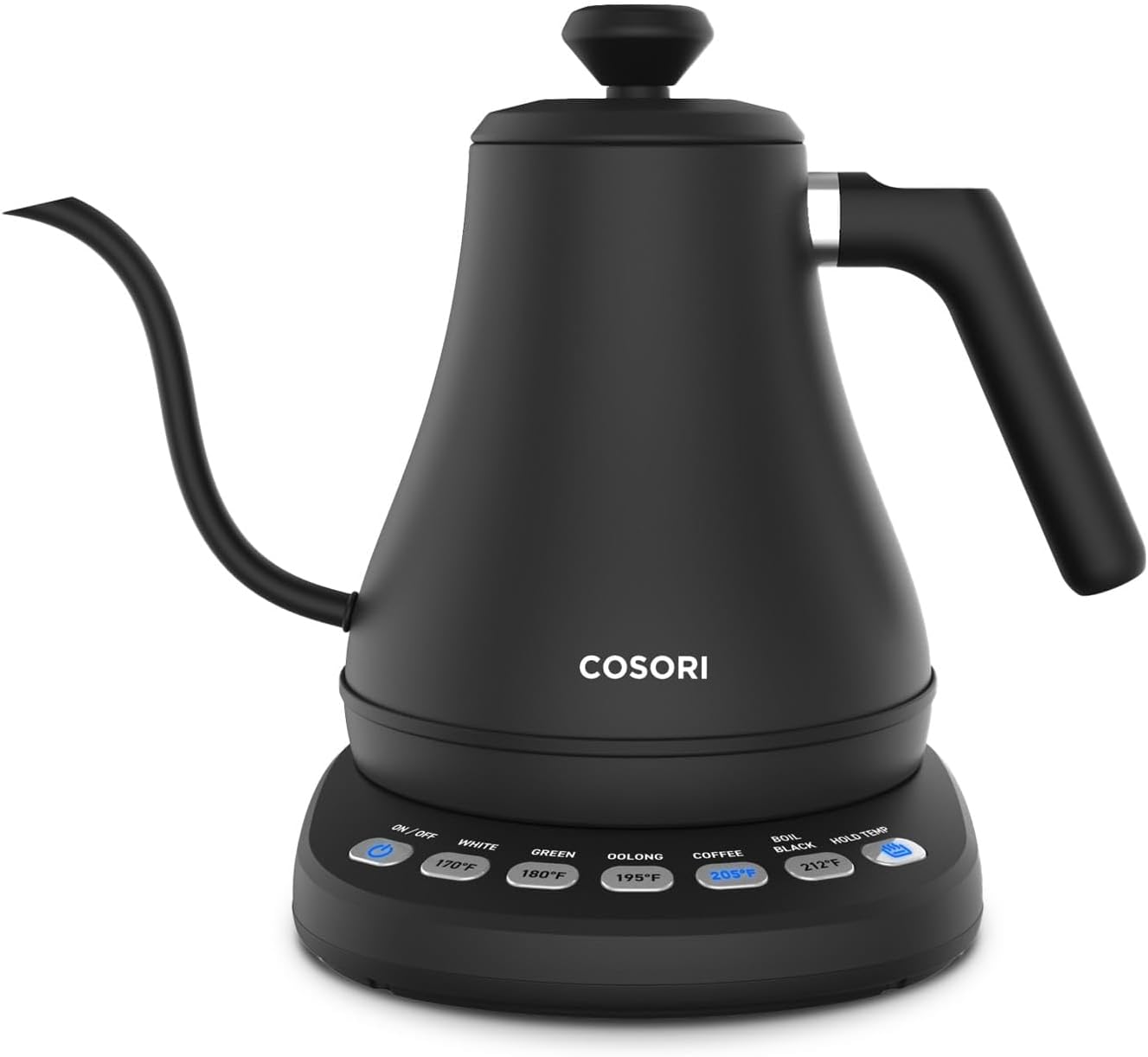
This one covers both ends of the day. In the morning it's a genuinely good pour-over kettle — per Cosori's own product page, it hits five preset temperatures (170°F for white tea, 180°F green, 195°F oolong, 205°F coffee, 212°F boiling for black tea) with a stainless-steel interior and no plastic touching the water, plus a 60-minute Hold Temp function. In the afternoon or evening, that same precision is what makes switching to decaf pour-over or a proper cup of herbal tea fast enough to actually happen instead of getting skipped for "just one more coffee, it's quicker." It won't sync to WHOOP or Oura — nothing in this guide does — but it removes the exact friction (slow, imprecise water temperature) that makes the tea swap annoying in the first place.
The Splurge: Café Specialty Grind & Brew WiFi Coffee Maker — ~$320+
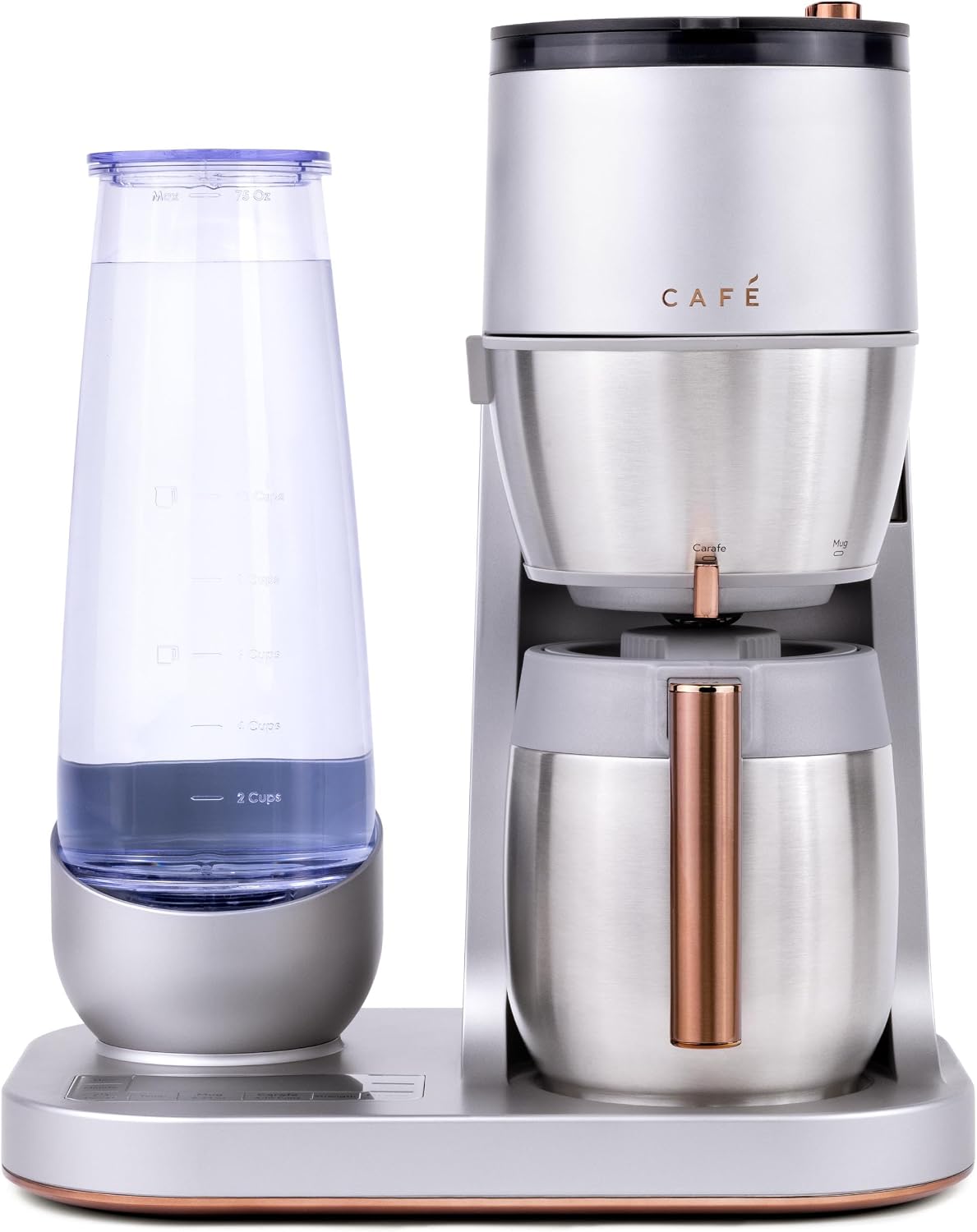
If you already run a smart-home routine and want this folded into it rather than bolted on, this is the pick — with the caveat that Amazon showed limited stock at the time of writing, so check availability before you count on it. Per Café Appliances' own product page, it connects over WiFi to the SmartHQ app, where you can schedule a brew up to 24 hours in advance, adjust bloom time, and get a notification when it's done, plus voice control through Amazon or Google Assistant. It grinds beans fresh per cup, brews single-serve up to a 10-cup thermal carafe, and is SCA-certified for meeting the Specialty Coffee Association's brewing standards — genuinely better coffee, not just a smarter clock. For this routine specifically, the value is the same as the Hamilton Beach at a tenth the price: one scheduled brew, no reason to make a second pot out of habit.
How to Actually Build the Routine
The gear only matters if it's wired into an actual routine. Here's the practical version:
- Schedule one brew, not on-demand coffee. Set the programmable timer the night before instead of brewing fresh each time you want a cup — this alone removes most of the "might as well make more" moments.
- Find your own cutoff hour, don't copy one. WHOOP's four-hour figure is an aggregate; your own Journal or Oura Trends data, built up over a few weeks of tagging, will tell you if your real number is earlier or later.
- Make the swap as fast as the bad option. Once you hit your cutoff, use the kettle's tea preset instead of walking back to the coffee maker — if the swap takes longer than pouring more coffee, you won't do it consistently.
- Log it. Answer the WHOOP Journal's caffeine question or tag caffeine in Oura on the nights you actually keep the cutoff and the nights you don't — that's the only way to see whether it's moving your own Recovery or Sleep Score, instead of assuming it does.
Hamilton Beach vs. Cosori vs. Café, Side by Side
| Feature | Hamilton Beach 46280J | Cosori Gooseneck Kettle | Café Grind & Brew WiFi |
|---|---|---|---|
| Approx. price | ~$40 | ~$50–70 | ~$320+ |
| Best for | One scheduled AM pot, hard auto-shutoff | Fast, correct-temp decaf/tea swap any time of day | Smart-home-integrated single brew |
| Scheduling | Program up to 24 hrs ahead | No scheduling — on-demand, five temp presets | SmartHQ app, schedule up to 24 hrs ahead |
| Auto-shutoff / hold | 4-hour auto-shutoff | 60-minute Hold Temp | Per SmartHQ settings; thermal carafe keeps brew hot without a hot plate |
| App / WiFi | None | None | WiFi, SmartHQ app, voice control |
| Stock at time of writing | In stock | In stock | In stock, limited quantity |
Reference prices at the time of writing; Amazon's price at checkout governs. Specs per each brand's official product page, cited in the Sources section below.
Caffeine Cutoff & Sleep Score FAQ
Does WHOOP actually connect caffeine timing to my Recovery Score?
Yes, through the WHOOP Journal. Per WHOOP's own analysis of member Journal data, consuming caffeine within four hours of bed was associated with a resting heart rate that rose by 2 beats per minute, an HRV drop of 6 milliseconds, roughly 7.5% lower Recovery, and almost a 1% drop in sleep efficiency. WHOOP itself frames this as a correlation from comparing your own logged yes/no nights, not a universal cause-and-effect rule, and per independent coverage of the feature, the Journal looks for at least five logged instances of a behavior before it shows you a personalized insight for it. Caffeine is also one of the specific behaviors the Journal has tracked since it added expanded Recovery Behaviours, independently confirmed by the5krunner's coverage of the feature.
Does Oura track caffeine the same way as WHOOP?
Similarly, but less automatically. Per Oura's own support documentation, the Oura app includes a built-in caffeine tag among more than 100 searchable tags, and Oura is explicit that tags don't directly change your Sleep or Readiness Score — you log the tag yourself, then use the Trends view to overlay it against your Sleep Score and look for a pattern. Oura's own blog features a member who used exactly this to discover that late afternoon coffee was quietly reducing his overall sleep quality. Independent coverage of the feature recommends tagging caffeine right when you drink it, not the next morning, for cleaner data.
Will a coffee maker or electric kettle actually stop me from drinking too much caffeine?
No, and we're not going to pretend otherwise. Nothing in a kitchen appliance can stop you from brewing a second pot at 4 p.m. What these tools remove is friction: a programmable coffee maker with a scheduled brew and an auto-shutoff means your one deliberate pot is ready when you wake up and isn't sitting on a hot plate all afternoon tempting a refill, and a temperature-controlled kettle makes brewing decaf or herbal tea at the correct temperature fast enough that it's a realistic swap instead of an extra step you skip when you're tired. The actual cutoff time is still a decision you make — WHOOP's own data suggests that decision is genuinely personal, not a number you copy from someone else.
What's the cheapest kitchen gear pick to start a caffeine-cutoff routine?
The Hamilton Beach 12 Cup Programmable Coffee Maker (46280J), confirmed in stock and priced at $39.99 on Hamilton Beach's own site. It programs up to 24 hours ahead and automatically shuts off after 4 hours of keeping coffee warm, which is the specific feature that nudges you toward one morning pot instead of a hot plate running all day.
Is decaf coffee or herbal tea a good swap for an afternoon cup of regular coffee?
It's a reasonable swap, but not a magic one — per Mayo Clinic, decaf coffee still contains a small amount of caffeine (typically a few milligrams per cup, far less than a regular cup, but not zero). Herbal tea (not green or black tea, which still contain real caffeine) is the closer-to-zero option. Either way, the point of a fast, temperature-controlled kettle is making that swap easy enough that you actually reach for it instead of walking back to the regular coffee maker out of habit.

Sources
- WHOOP — What a Year of WHOOP Data Can Teach You About Sleep and Recovery: official source for the caffeine-within-4-hours stats (RHR, HRV, Recovery, sleep efficiency).
- WHOOP — How the WHOOP Journal Helps You Track Habits, Sleep, and Recovery: Journal mechanics — more than 40 trackable behaviors at launch (expanded since), and the yes/no comparison method behind personalized insights.
- WHOOP — "Having 2-4 servings of caffeine can actually boost Recovery": official WHOOP social post, used here only for the balance nuance that caffeine timing, not caffeine itself, is what WHOOP's data flags.
- the5krunner — WHOOP - new Recovery Behaviours: independent confirmation of well over 100 trackable tag types and the roughly 5-logged-response threshold before WHOOP surfaces a personalized insight for a given behavior, including caffeine.
- Oura Member Care — Using Tags: official confirmation of the built-in caffeine tag among 100+ tags, and that tags don't directly alter scores.
- Oura — Introducing an Improved Tagging Experience: Sleep Score tag-suggestion feature and the member story about late-afternoon coffee.
- SimpleWearableReport — How to Use Oura Ring Tags: independent tip on tagging caffeine at the moment of consumption for cleaner data.
- Mayo Clinic — Caffeine content for coffee, tea, soda and more: confirms decaf coffee still contains a small amount of caffeine.
- Cosori — Original Electric Gooseneck Kettle (CO108-NK): official specs for the five temperature presets and Hold Temp feature.
- Café Appliances — Grind and Brew Coffee Maker: official specs for SmartHQ app scheduling, voice control and SCA certification.
- Hamilton Beach — 12 Cup Programmable Coffee Maker, Matte Black - 46280J: official specs for 24-hour programming, 4-hour auto-shutoff, and $39.99 list price.