How Heavy Should a Weighted Blanket Be? (Weight Chart by Body Weight)
Quick answer: A weighted blanket should weigh about 10% of your body weight, and anything from 8% to 12% is a normal range. That works out to a 12 lb blanket at 120 lb, 15 lb at 150 lb and 20 lb at 200 lb. If your number lands between two sizes, buy the lighter one. Heavier isn't better. Nothing we found shows extra pounds work harder, but they do make a blanket harder to move under and easier to overheat. Babies should never sleep under one. If you have sleep apnea, skip it: Sleep Foundation and Cleveland Clinic both say to avoid weighted blankets. For asthma or other breathing problems, heart or circulation issues, low blood pressure, diabetes or claustrophobia, talk to a doctor first, and ask a pediatrician before using one with a child.
Most weighted blanket listings give you the same menu: 10 lb, 15 lb, 20 lb, 25 lb. And almost no help picking. Go too light and it feels like a slightly dense quilt. Go too heavy and you're trying to roll over at 2 a.m. like there's a sandbag on your chest.
The sizing math is simple, and the chart below does it for you. The famous "10% rule" is just a convention. So this guide covers where the number comes from, when to bend it, and the questions people keep asking Google: whether a 130 lb person can use a 20 lb blanket, whether 20 lb is too much, what a 120 lb woman should buy, and what the downsides are.
- The rule: body weight × 0.10. The comfortable band runs from × 0.08 to × 0.12.
- Between two sizes: go lighter, especially if you sleep on your side or run warm.
- Too heavy if: you can't roll over easily, it presses on your chest, or you wake up overheated.
- Who should skip or ask first: infants never; sleep apnea, skip it; asthma or other breathing problems, circulation or low blood pressure, diabetes, claustrophobia, ask a doctor first; kids, ask a pediatrician.
What's the Rule for How Heavy a Weighted Blanket Should Be?
Nearly every source lands on the same number. Sleep Foundation says experts generally recommend about 10% of your body weight, with preferred weights running from about 5% to 12%.5, 6 Baloo Living, a blanket brand, recommends 8% to 12%.8 Casper says a flat 10%.9 The chart and the rest of this guide use Baloo's tighter 8% to 12% band.
Where does the number come from? Not, as far as we can tell, from a lab that tested 8% against 12%. The 2024 pilot trial in BMC Psychiatry picked a 5.5 kg (about 12 lb) glass-bead blanket because earlier studies "generally suggested" about 10% of body weight, and its participants averaged 56.3 kg (about 124 lb).2 The 2020 trial in psychiatric patients handed people an 8 kg (about 17.6 lb) chain blanket and let them step down to 6 kg (about 13 lb) if it felt too heavy. Ten of the 64 people in the weighted group did.1
Both trials compared a weighted blanket against a lighter one. Neither compared one weight against another. So treat 10% as a sensible starting point that a lot of people and brands have converged on. As far as we can tell, nobody has tested 10% as the sweet spot. Even a blanket listing follows it: the 12 lb, 48 × 72 inch YnM listing is labeled for about 110 lb, which is right around 10%.
Weighted Blanket Weight Chart: Body Weight to Blanket Weight
Find your weight in the first column. The last column is what to shop for. The middle three show the 8% to 12% band, so you can see how much room you have either way.
| Your body weight | 8% (light) | 10% (the rule) | 12% (firm) | Shop for |
|---|---|---|---|---|
| 100 lb | 8 lb | 10 lb | 12 lb | 10 lb |
| 110 lb | 8.8 lb | 11 lb | 13.2 lb | 10–12 lb |
| 120 lb | 9.6 lb | 12 lb | 14.4 lb | 12 lb |
| 130 lb | 10.4 lb | 13 lb | 15.6 lb | 12–15 lb |
| 140 lb | 11.2 lb | 14 lb | 16.8 lb | 12–15 lb |
| 150 lb | 12 lb | 15 lb | 18 lb | 15 lb |
| 160 lb | 12.8 lb | 16 lb | 19.2 lb | 15–17 lb |
| 170 lb | 13.6 lb | 17 lb | 20.4 lb | 17 lb |
| 180 lb | 14.4 lb | 18 lb | 21.6 lb | 15–20 lb |
| 190 lb | 15.2 lb | 19 lb | 22.8 lb | 20 lb |
| 200 lb | 16 lb | 20 lb | 24 lb | 20 lb |
| 225 lb | 18 lb | 22.5 lb | 27 lb | 20–25 lb |
| 250 lb | 20 lb | 25 lb | 30 lb | 25 lb |
| 300 lb | 24 lb | 30 lb | 36 lb | 25–30 lb |
The math is body weight × 0.08, × 0.10 and × 0.12. "Shop for" rounds to sizes brands commonly sell (10, 12, 15, 17, 20, 25 and 30 lb) and leans lighter when two sizes both fit. Not every brand makes a 17 lb blanket.
Got your number? Jump to blankets that come in your weight. And if you're still deciding whether a weighted blanket is the right fix at all, our weighted blanket vs sunrise alarm clock breakdown goes through what the research actually shows.
A couple of things the chart can't tell you. "Body weight" means the person under the blanket, not the bed. And if two of you share a bed, Baloo's suggestion is two individual throws, or a weighted comforter built to be shared.8
Weighted Blanket Weight Guide: When to Go Lighter (or a Little Heavier)
The chart gets you close. These are the situations where the sources say to nudge it.
Go lighter than the chart if:
- You're between two sizes. Baloo says start with the lighter one. Casper says round up a pound or two. We'd go lighter: a blanket that feels a little gentle is easier to live with than one you have to fight, and Sleep Foundation's own test for "too heavy" is whether it's hard to move under.6, 8, 9
- You sleep on your side. Baloo says a heavy blanket lands on your hips, shoulders and joints and might cause soreness, while back and stomach sleepers can take the heavier end. Comma Home also says side sleepers should go slightly lighter. That's brand advice without clinical evidence behind it, but the sources agree.8, 10
- You're over 65 or dealing with joint pain. Baloo puts both groups in the lighter camp.8
- You run hot. Sleep Foundation says a blanket that "causes overheating" may be too heavy, and Comma Home suggests staying at the low end of your range in warm weather.6, 10
- You've never used one. Comma Home's advice is to start near 10% and build up gradually if you want more.10
Stay at 10% to 12% if you sleep on your back or stomach and you already know you like firm pressure. Going past 12% isn't backed by anything we read.
One honest counterpoint: in the 2020 trial's open follow-up, the authors note that after four weeks of use most participants picked a heavier blanket. That's self-selection in psychiatric patients and isn't a recommendation. So "lighter" here is advice for a first buy, and it can change once you know what you like.1
One more wrinkle: the same pounds spread over more fabric feel lighter. Baloo says its 25 lb king-size blanket feels closer in density to its 15 lb one. Take that as a brand claim, but it's a fair reason to be careful comparing pounds across very different blanket sizes.8
Can a 130 lb Person Use a 20 lb Weighted Blanket?
Physically, yes. A healthy adult who can move the blanket on their own can. Practically, it's a poor first choice. Twenty pounds is about 15% of 130 lb, past the 12% top of the range Sleep Foundation and Baloo describe. The 10% pick is 13 lb, so a 12 or 15 lb blanket is the better buy.
Comma Home has a whole page on this exact question and reaches the same answer: 13 lb recommended, 6.5 to 15.6 lb as the range, and start closer to 10% before building up. Its warnings are worth repeating: too much weight on your chest can make breathing feel labored, and feeling trapped or uncomfortable disrupts sleep.10
Is a 20 lb Weighted Blanket Too Much?
It depends entirely on your weight. Inside the 8% to 12% band, a 20 lb blanket fits people from roughly 167 to 250 lb, and at 200 lb it's an exact 10%. Under about 165 lb it's probably too heavy. Above 250 lb the band moves past 20 lb, and that's where the 25 lb and 30 lb sizes come in.
That's why 20 lb is such a common adult size: Casper puts the typical adult range at 12 to 20 lb.9 It fits a big chunk of adults, but a 120 or 130 lb person shouldn't buy it just because it's the default on the listing.
What Size Weighted Blanket for a 120 lb Woman?
Weight: 12 lb. That's exactly 10% of 120 lb, and the 8% to 12% band runs from 9.6 to 14.4 lb, so 10 to 14 lb all fit. If you sleep on your side or you've never used a weighted blanket, 10 lb is a reasonable place to start. None of the sizing guides we read adjust the rule for sex. It runs off body weight.
Dimensions: "Size" can also mean the blanket's length and width. For one person, a throw or twin size (around 48 × 72 inches) is the common fit. A 60 × 80 inch queen-size blanket is built to lie across the top of a bed, and Baloo describes its Full/Queen as covering just the top of the mattress with minimal overhang.8 If you pick a bigger blanket, remember the weight spreads out and feels lighter.
How Heavy Should a Weighted Blanket Be for a Child?
Babies and toddlers: never. The American Academy of Pediatrics' HealthyChildren.org says not to use weighted blankets, sleepers, swaddles or other weighted objects on or near your baby.13 The U.S. Consumer Product Safety Commission's safe-sleep warning is the same: don't use weighted blankets or weighted swaddles for babies. Commissioner Richard Trumka repeated it in an April 2024 statement.14
Older children: the sources set stricter limits than the adult rule, and they don't fully agree with each other. Gillette Children's says weighted blankets are not intended for overnight use and should come off once the child falls asleep, that kids should use one for only 15 to 20 minutes at a time with a one-to-two-hour break before putting it back on, and that it's for use under an adult's supervision. It also says never under age 2, in general no more than 10% of the child's body weight, the child has to be able to remove it or get their arms and legs out on their own, never over the head or neck, and not so big it hangs off the bed.12 Sleep Foundation frames it differently: generally considered safe for children 3 and older who weigh at least 50 lb, with a family physician helping pick the weight. It also tells parents to use caution with the 10% rule for kids and to err toward the lower end.5 We'd follow the stricter source. That means a weighted blanket for a child is something to run past a pediatrician first. We haven't included any kids' blankets in this guide on purpose.
Are There Any Downsides to Weighted Blankets?
Yes, and the listing photos skip most of them.
- Heat. Sleep Foundation says a blanket that causes overheating may be too heavy, and Comma Home notes that heavy blankets can trap heat in warm climates.6, 10 If heat is the dealbreaker for you, our guide to weighted blankets for hot sleepers breaks down where the heat comes from and which designs hold less of it.
- Feeling trapped. In the 2020 trial, one participant dropped out because the blanket made them anxious. It was the only side effect the trial reported, but it's a real thing that can happen.1
- Health conditions. Sleep Foundation says people with obstructive sleep apnea should avoid weighted blankets, because added pressure on the chest may further restrict airflow. A Cleveland Clinic news article says experts advise people with respiratory problems like sleep apnea, diabetes or severe heart conditions to avoid them, since the added pressure could be unsafe.7, 11 For asthma or other chronic respiratory issues, circulatory problems or low blood pressure, type 2 diabetes and claustrophobia, Sleep Foundation's advice is to talk to a doctor first. You also need enough strength and mobility to remove the blanket yourself.7
- The evidence is thinner than the marketing. A 2020 systematic review found only 8 studies and concluded blankets may help with anxiety, but that there wasn't enough evidence for insomnia.4 The 120-patient trial found better Insomnia Severity Index scores than a light plastic-chain blanket.1 The 102-patient pilot found better sleep quality (PSQI) than a 3.5 kg regular blanket, but no significant change in insomnia severity or in awakenings measured by actigraphy.2 And the main randomized trial in autistic children found no objective gain in sleep time, even though kids and parents preferred the weighted blanket.3 Sleep Foundation calls them a supportive tool, not a standalone treatment.6
If a low sleep-tracker score is what sent you shopping, our what to buy when your sleep score is bad guide covers what a weighted blanket can and can't do for that number.
How Can You Tell a Weighted Blanket Is Too Heavy?
- You can't roll over or pull your legs out without a struggle.
- You feel pressure on your chest, or your breathing feels labored.
- You wake up hot or sweaty.
- You feel pinned down or anxious instead of calm.
- Your shoulders or hips ache in the morning, which is most common for side sleepers.
If two or more of those sound familiar, drop down a size. The 2020 trial's own step-down was from 8 kg to 6 kg, roughly 17.6 lb to 13 lb, so a two-to-five pound cut is a reasonable move.1
Which Weighted Blankets Come in the Weight You Need?
You've got your number. Not every blanket comes in every weight, though. These four listings were in stock when we checked on September 27, 2026, and the weights below are the options each Amazon page shows. Sizes and colors change, so confirm your weight is selectable before you order.
| Blanket | Weights listed | Worth knowing | |
|---|---|---|---|
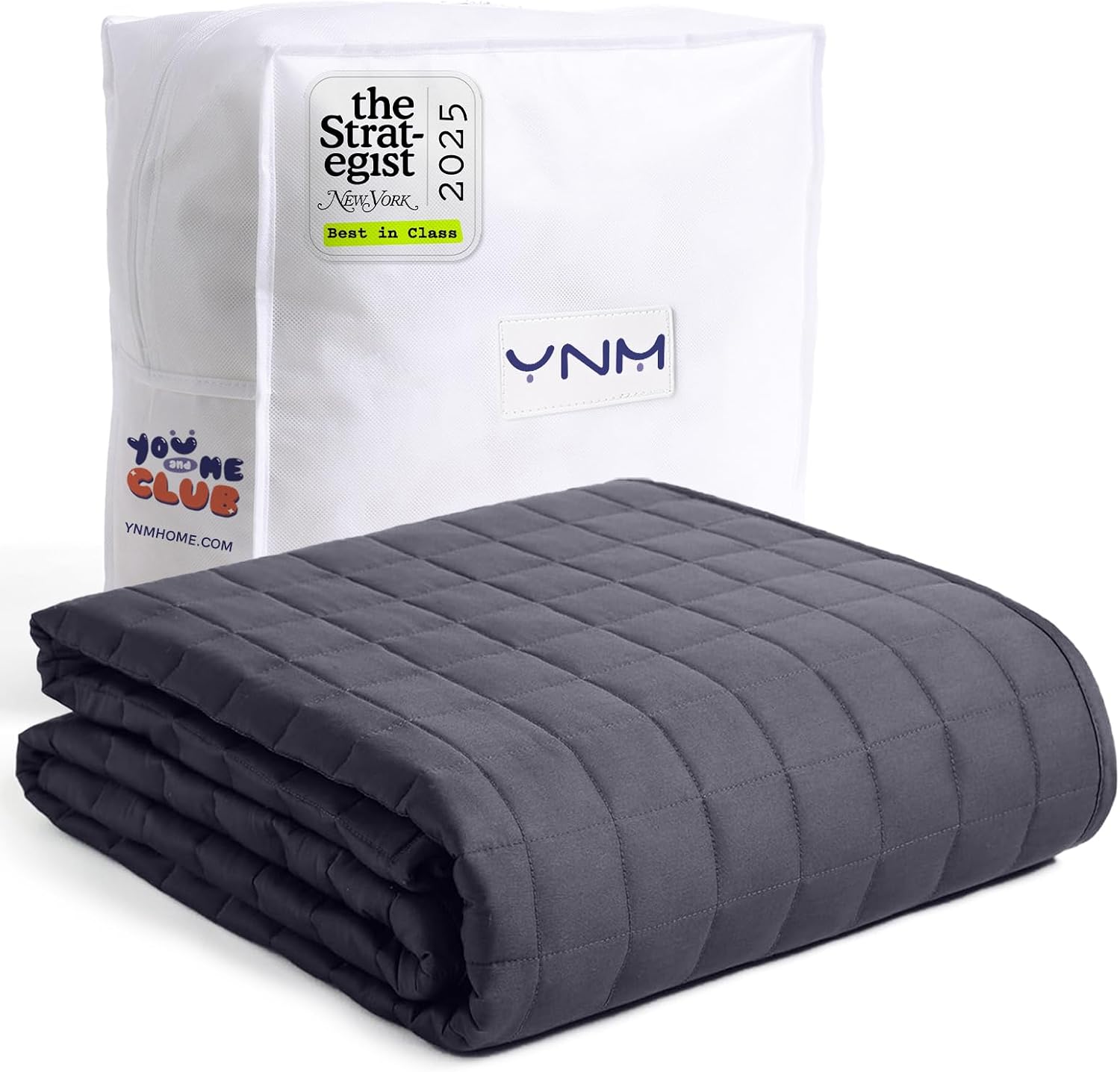
| YnM (glass beads, quilted) | 10, 12, 15, 17, 20, 25, 30 lb, plus oversize 40 and 50 lb | Widest range of the four, with cotton, microfiber and "cooling" covers. The only one that lists 30 lb. | Check YnM sizes Paid link |
| Kivik (layered, minky dot) | 10, 12, 15, 20, 25 lb | Seven-layer design and a reversible cover, per the listing. The 12 and 15 lb come in 48 × 72, and the 15 and 20 lb in 60 × 80. | Check Kivik sizes Paid link |
| ZonLi (glass beads) | 12, 15, 17, 20, 25 lb | One of two listings here with a 17 lb option, which is handy around 170 lb. | Check ZonLi sizes Paid link |
| Bearaby Cotton (hand-knit, no beads) | 10, 15, 20 lb | Open chunky knit with no bead filling, so it looks and feels different. Only three weights, and a much higher price tier than the other three. | Check Bearaby sizes Paid link |
Two gaps to be upfront about. Above 25 lb, only the YnM listing shows options, so if the chart sends you to 30 lb your choices are narrow. And we're not recommending a kids' blanket at all, for the safety reasons above. Some of these listings also sell sizes under 10 lb, including small lap and kids' sizes. We left those out of the table on purpose and don't recommend weighted blankets for young children. Our sleep tech gifts guide has more on where a weighted blanket fits alongside other sleep gear.
Weighted Blanket Weight FAQ
How heavy should a weighted blanket be?
About 10% of your body weight, with 8% to 12% as the normal range. A 150 lb adult lands on a 15 lb blanket, a 200 lb adult on 20 lb. If your number falls between two sizes, go with the lighter one.
What weighted blanket weight do I need for my body weight?
Use the weight chart above: roughly 10 lb at 100 lb, 12 lb at 120 lb, 15 lb at 150 lb, 15 to 20 lb at 180 lb, 20 lb at 200 lb and 25 lb at 250 lb. Those come from body weight × 0.10, rounded to sizes brands actually sell.
Can a 130 lb person use a 20 lb weighted blanket?
Physically, a healthy adult can, but it's a poor first choice. 20 lb is about 15% of 130 lb, above the 12% top end that both Sleep Foundation (5% to 12%) and Baloo Living (8% to 12%) describe. The 10% pick is 13 lb, so shop 12 or 15 lb instead.
Is a 20 lb weighted blanket too much?
It depends on your weight. In the 8% to 12% band, 20 lb fits people from roughly 167 to 250 lb, with 200 lb being an exact 10%. Under about 165 lb it's probably too heavy.
What size weighted blanket for a 120 lb woman?
A 12 lb blanket, which is exactly 10% of 120 lb. Anything from 10 to 14 lb sits inside the 8% to 12% band, and 10 lb is a reasonable pick if you sleep on your side. For dimensions, a throw or twin size (around 48 × 72 inches) is a common fit for one person.
Are there any downsides to weighted blankets?
Yes. They can run hot, a blanket that's too heavy is hard to move under, and some people feel trapped or anxious under one. Sleep Foundation says people with obstructive sleep apnea should avoid weighted blankets because added pressure on the chest may further restrict airflow, and a Cleveland Clinic news article says experts advise the same for people with respiratory problems like sleep apnea. For asthma or other chronic breathing problems, circulation or low blood pressure issues, type 2 diabetes or claustrophobia, Sleep Foundation says to talk to a doctor first. Babies should never use one. The research is also thinner than the marketing suggests.
Should I go lighter or heavier if I'm between two sizes?
Lighter. Baloo Living says to start with the lighter blanket when you fall between sizes, and Sleep Foundation's test for 'too heavy' is whether the blanket is hard to move under or causes overheating. Casper suggests rounding up a pound or two, so the advice isn't unanimous, but lighter is the easier mistake to live with.
Do side sleepers need a lighter weighted blanket?
Usually, yes. Baloo Living and Comma Home both say side sleepers should go a bit lighter, since the weight lands on the hips, shoulders and joints. That's brand guidance rather than clinical evidence, but the sources agree.
Is there a weighted blanket weight guide for kids?
Not a chart we'd hand out. Babies should never use a weighted blanket. For older children the sources are stricter than the adult rule, and they don't fully agree. Gillette Children's says never under age 2, no more than about 10% of the child's weight, adult supervision only, and that weighted blankets are not intended for overnight use and should come off once the child falls asleep. Sleep Foundation says generally age 3 and up and at least 50 lb, cautions parents about using the 10% rule for kids, and suggests erring toward the lower end. Check with a pediatrician first, and the child must be able to remove the blanket on their own.
What weight should I buy if I'm giving a weighted blanket as a gift?
Ask if you can. If you can't, a 15 lb blanket sits inside the 8% to 12% band for anyone from roughly 125 to 187 lb, which covers a lot of adults. More ideas are in our sleep tech gifts guide.
Sources
- Ekholm B, Spulber S, Adler M. A randomized controlled study of weighted chain blankets for insomnia in psychiatric disorders. Journal of Clinical Sleep Medicine, 2020: 120 patients; weighted chain blanket (8 kg, step-down to 6 kg) vs a 1,535 g plastic-chain control, better Insomnia Severity Index at 4 weeks (P < .001); ten of 64 stepped down to 6 kg; one dropout from blanket-related anxiety; in the open phase most participants later chose a heavier blanket. PubMed
- Yu J, Du J, Yang Z, et al. Effect of weighted blankets on sleep quality among adults with insomnia: a pilot randomized controlled trial. BMC Psychiatry, 2024: 102 adults; 5.5 kg glass-bead blanket (chosen from the ~10% of body weight convention) vs a 3.5 kg regular blanket; better sleep quality on PSQI (P = 0.006), no significant change in Insomnia Severity Index (P = 0.233) or in actigraphy awakenings (P = 0.280). PubMed
- Gringras P, et al. Weighted blankets and sleep in autistic children — a randomized controlled trial. Pediatrics, 2014: no objective gain in total sleep time; blankets well tolerated and preferred by children and parents. PubMed
- Eron K, Kohnert L, Watters A, et al. Weighted Blanket Use: A Systematic Review. American Journal of Occupational Therapy, 2020: 8 studies; possibly useful for anxiety, not enough evidence for insomnia (literature search ran in early 2018). PubMed
- Sleep Foundation — How Heavy Should a Weighted Blanket Be? (updated Nov 20, 2024): 10% rule, 5% to 12% preferred range; children generally 3 and older and at least 50 lb, caution with the 10% rule for kids, consult a family physician, err toward the lower end.
- Sleep Foundation — How Do Weighted Blankets Work? (updated June 10, 2025): 10% guidance, the "hard to move under or causes overheating" sign, a supportive tool rather than a standalone treatment.
- Sleep Foundation — Weighted Blanket Benefits (updated June 4, 2025, medically reviewed): people with obstructive sleep apnea should avoid weighted blankets; asthma or chronic respiratory issues, circulatory problems or low blood pressure, type 2 diabetes and claustrophobia are reasons to talk to a doctor first; never for infants or toddlers.
- Baloo Living (brand guidance, not clinical evidence) — How to Choose a Weighted Blanket and sizing guide: 8% to 12% range, lighter when between sizes, side sleepers, over 65 or joint pain, blanket dimensions.
- Casper — How Heavy Should a Weighted Blanket Be? (Aug 2020): flat 10% rule, typical adult range 12 to 20 lb, round up one to two pounds when between sizes.
- Comma Home — Can a 130 lb Person Use a 20 lb Weighted Blanket? (13 lb recommended, 6.5 to 15.6 lb range, start near 10%, breathing cautions) and Choosing the Right Weighted Blanket Weight (side sleepers, heat in warm climates).
- Cleveland Clinic Newsroom — Do Weighted Blankets Really Work? (Jan 29, 2025, article quoting sleep psychologist Alicia Roth, PhD): the article says experts advise people with respiratory problems like sleep apnea, diabetes or severe heart conditions to avoid weighted blankets because the added pressure could be unsafe. Roth is quoted on comfort and individual variation, not on that warning.
- Gillette Children's — Weighted Blankets (patient education): not intended for overnight use and removed once the child falls asleep; 15 to 20 minutes at a time with a one-to-two-hour break; never under age 2; in general no more than 10% of the child's body weight; the child must be able to remove it; adult supervision; never over the head or neck; not so large it hangs off the bed.
- HealthyChildren.org (American Academy of Pediatrics) — A Parent's Guide to Safe Sleep: no weighted blankets, sleepers, swaddles or other weighted objects on or near a baby.
- U.S. Consumer Product Safety Commission — Commissioner Trumka statement on weighted infant swaddles and blankets (Apr 15, 2024): repeats the safe-sleep warning "Don't" use weighted blankets or weighted swaddles for babies, and cites NIH, CDC and AAP guidance to the same effect.