Emporia Vue 3 Review: Is It Worth It After Sense Discontinued Hardware?
Quick answer: Yes, for most people who want real circuit-level energy data and are okay with an install inside their breaker panel. The Emporia Vue 3 (~$179, in stock as of this writing) measures up to 16 individual circuits at a claimed ±2% accuracy against utility metering,1 and it has never charged a subscription — not even as an optional upgrade.2 The honest catch: it's a cloud-only device with no official public API,3 so if you were hoping for true local control or an out-of-the-box Home Assistant integration, it doesn't ship with one — what it has instead is an unusually large unofficial developer community filling that gap.
Part of why this device is suddenly getting searched more is that Sense stopped selling its energy monitor to consumers on December 31, 2025, shifting its technology into utility smart-meter partnerships instead.7 We covered that transition and the head-to-head differences in a separate piece — Sense Energy Monitor Alternatives — so this review stays focused on the Vue 3 itself: what it does well, where it actually falls short, and whether it's worth $179 of your money on its own merits.
- Best for: homeowners who want per-circuit visibility, not just a whole-home guess
- Price: around $179 for the standard kit (Emporia sells multiple sensor-count configurations, so check the live price)
- No subscription, ever — not even an optional paid tier exists right now
- No official API — but a large, actively maintained community integration ecosystem
- Biggest catch: fully cloud-dependent; no local data access, no offline app
What Is the Emporia Vue 3, and Why the Sudden Interest?
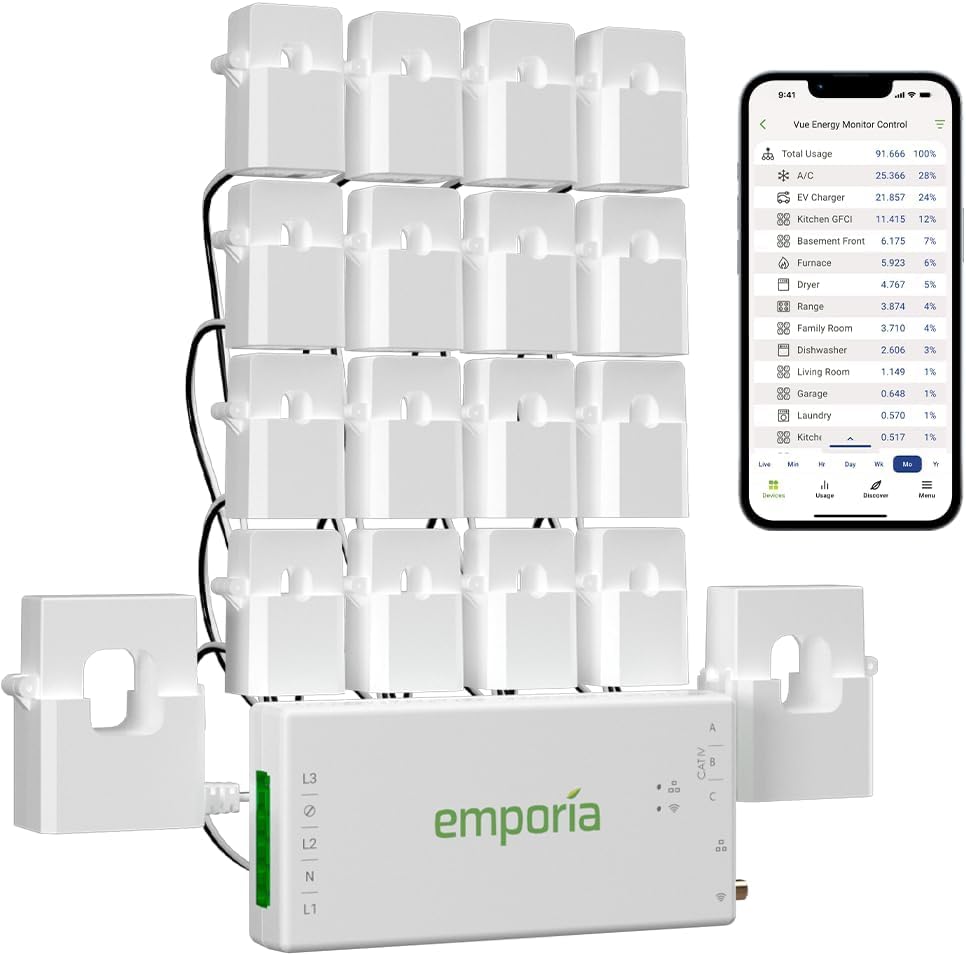
The Vue 3 is Emporia's current-generation whole-home energy monitor: a small hub that installs inside your breaker panel, paired with clamp-on current sensors you attach to individual circuit breakers and to the main feed. Instead of estimating usage from a single whole-home signal, it reports back exactly what each monitored circuit is drawing, in something close to real time, through Emporia's free app.
Interest in it has picked up for a specific reason: Sense, previously the best-known name in this category, confirmed on its own blog that it stopped selling new hardware to consumers as of December 31, 2025, choosing instead to fold its detection technology into utility smart meters through partnerships rather than continue shipping a standalone box.7 That's left the Vue 3 as one of the few remaining actively-sold, well-documented panel-level monitors — which is also exactly why the search results for "Emporia Vue review" right now are dominated by small, low-effort content sites rather than an actual hands-on breakdown. This review is us trying to be the second kind.
How the Emporia Vue 3 Actually Works
The kit ships with current-transformer (CT) clamp sensors — the Vue 3 supports up to 16 branch-circuit sensors plus sensors on the mains, rated up to 250A using the included 200A CT sensors, per Emporia's own technical documentation.1 Each clamp physically wraps around the wire feeding one breaker; it doesn't touch or cut the conductor, it just reads the magnetic field created by current flow. That's a meaningfully different approach from Sense's two-clamp, whole-home setup, which instead uses machine learning to guess which appliance just switched on from a combined electrical signature.7 With the Vue 3, if you label a clamp "kitchen outlets," the app already knows that circuit is the kitchen — there's no learning period.
Emporia rates the Vue 3's accuracy at ±2% compared to utility meter readings,1 and says app data is typically updated within a few seconds of being measured1 — close enough to real time that you can watch a specific appliance's draw change as it cycles on and off. That responsiveness is genuinely the strongest part of the day-to-day experience described in Emporia's own materials and in third-party writeups we cross-checked: this is a monitor built to show you what's happening right now, not just a monthly summary.
Does the Emporia Vue 3 Require a Subscription?
No — and this is worth stating plainly because it's easy to assume a cloud-connected device with a companion app has a paid tier hiding somewhere. It doesn't, currently. Emporia's own help center is direct about this: "no subscription, no monthly fees, no tiers," and once you buy the hardware "you own it outright" with "no recurring charges, no premium feature unlocks, and no hidden fees."2 Cloud data storage is included at no extra cost, and Emporia doesn't currently publish any paid "Plus" plan or optional premium unlock — every core feature (real-time monitoring, circuit history, alerts, solar/net-metering support) ships with the hardware purchase.
That's a real point in its favor next to some smart-home categories where basic history gets capped unless you subscribe. It's also a detail worth double-checking yourself before you buy, since companies do sometimes introduce tiers later — but as of this writing, there's nothing to sign up for beyond creating a free Emporia account.
Is There an Open API? What "Open" Actually Means Here
This is the point where a lot of coverage overstates things, so we went straight to Emporia's own developer documentation instead of repeating what other sites say. The answer is more nuanced than "open API": Emporia does not currently offer a public API for direct programmatic access to device or account data.3 That's Emporia's own wording, not our interpretation — there is no official, documented, supported endpoint you can plug into.
What actually exists is a large, unofficial developer ecosystem that Emporia is aware of and tolerates rather than blocks. Emporia's help center itself points curious users toward community-built tools including PyEmVue, a Python library for pulling data from the same cloud service the app uses, while stating plainly: "these projects are developed and maintained independently of Emporia Energy. We are not able to officially support them."3 On top of PyEmVue, there are multiple actively maintained Home Assistant custom integrations built by different developers, and a separate open-source firmware project that lets you reflash the Vue 3 hardware to publish data over MQTT for fully local use — though doing that replaces the stock firmware, meaning you give up the official Emporia app entirely on that unit.
So the honest framing is this: no official API, but a real and mature workaround culture that Emporia hasn't shut down — a meaningfully more open posture than a fully closed system, even without formal documentation or support behind it. If "official, documented API with SLA support" is a requirement for you, the Vue 3 doesn't clear that bar today. If "someone else has already built and maintained the integration I want" is enough, it very likely does.
Installing the Vue 3 — Can You DIY It?
The Vue 3 is not a plug-in device — it installs inside your breaker panel, and Emporia is upfront about what that involves. Setup means opening the panel's dead-front cover, clamping the included current sensors around the wires feeding whichever circuits you want to track, and wiring (or pigtailing into) a small breaker to power the unit itself.
Emporia's own installation guidance says you're a reasonable DIY candidate if you're comfortable safely removing the panel cover, can identify phase, neutral and ground conductors, and can install or pigtail a small breaker — and the company explicitly recommends hiring a licensed electrician if you're not comfortable with any of that, or if your local code requires a licensed installer.6 Even with the main breaker off, the service-entrance conductors feeding the panel stay energized, so treat "electrician" as the safe default rather than an admission of failure if you've never worked inside a panel before.
The Real Downsides
No product in this category is subscription-free and fully local and plug-and-play — something gives, and with the Vue 3 it's local control and data retention depth.
It's completely cloud-dependent. Every measurement flows through Emporia's servers before it reaches the app; there's no local API and no way to view live data without an internet connection, even from a device sitting on your own home network.4 Emporia's own documentation on offline behavior says outages under roughly 15 minutes don't lose data — the Vue buffers readings locally and uploads them once your connection returns — but past about 15 minutes offline, readings during the outage get averaged instead of stored at full resolution.4 If your internet is unreliable, expect gaps in your highest-detail history.
High-resolution history doesn't stick around long. Per Emporia's documentation on data storage, second-by-second detail isn't kept indefinitely, and even 1-minute-interval data is retained for a limited window before it ages out — Emporia's guidance points users toward exporting that data manually via CSV if they want to keep it long-term.5 Longer-interval summaries (hourly/daily) stick around much longer, so this mainly matters if you specifically want to go back and analyze minute-by-minute detail from weeks ago.
It's a bigger up-front project than a smart plug. There's no version of this that's "unbox it, plug it in, done" — you're either comfortable working inside an energized panel or you're budgeting for an electrician's time on top of the hardware cost.
Emporia Vue 3 vs. Sense — Quick Context
If you're here because your Sense monitor is discontinued and you're trying to decide what replaces it, the short version: Sense measured only at the mains and used machine learning to guess individual appliances from the combined signal, while the Vue 3 measures each circuit directly with its own sensor, trading a slightly bigger install for zero guesswork.7 Neither one has ever required a paid subscription for its core features. For the full circuit-by-circuit comparison, installation differences, and what happened to the older Vue Gen 2, see our dedicated Sense Energy Monitor Alternatives guide — this review is deliberately focused on judging the Vue 3 on its own, not as a stand-in for something else.
Pros and Cons
- No subscription, no tiers, no optional paid unlock — ever, as of this writing
- Circuit-level data (up to 16 circuits), not a whole-home guess
- ±2% accuracy claim against utility metering
- App updates within seconds — genuinely close to real time
- Large unofficial developer ecosystem (PyEmVue, Home Assistant integrations, local firmware option) that Emporia tolerates rather than blocks
- No official public API — anything programmatic runs through unofficial, unsupported tools
- 100% cloud-dependent; no local API or local data access from the app
- Data resolution degrades during internet outages over ~15 minutes
- Highest-resolution (1-minute) history isn't retained long-term unless you export it yourself
- Requires opening your breaker panel — not a plug-and-play device
Is the Emporia Vue 3 Worth It in 2026?
Judged on its own — not just as "the thing you buy because Sense is gone" — the Vue 3 earns its price for a specific kind of buyer: someone who wants to know exactly which circuit is driving their electric bill, is fine opening a breaker panel (or paying someone who will), and doesn't want a subscription hanging over a device they already bought outright. The accuracy claim, the lack of any paid tier, and the sheer size of the unofficial integration community are all real, verifiable strengths.
It's a worse fit if you specifically need an official, supported API for a commercial or mission-critical integration, if you want guaranteed offline functionality, or if you were hoping for a simpler plug-in install rather than panel work. For those cases, the Vue 3's honest limitations — cloud-only, no official developer program, install complexity — are the reasons to hold off rather than reasons to distrust the product.
Emporia Vue 3 Review FAQ
Is the Emporia Vue 3 worth it in 2026?
For most people who want circuit-level energy data and don't mind a panel install, yes. It measures up to 16 circuits at ±2% accuracy, never charges a subscription, and costs roughly $179. The trade-off is that it's cloud-only with no official public API.
Does the Emporia Vue 3 require a subscription?
No, not even as an optional upgrade. Emporia's help center states there's no subscription, no monthly fees and no tiers — you own the hardware outright, with unlimited cloud storage included.
Does the Emporia Vue 3 have an open API?
Not officially. Emporia's own documentation says it doesn't currently offer a public API. What exists instead is a large unofficial ecosystem — PyEmVue, several Home Assistant integrations, and a local ESPHome firmware option — that Emporia acknowledges but doesn't officially support.
What happens to the Emporia Vue 3 if my internet goes down?
Short outages (under ~15 minutes) don't lose data — it buffers and uploads later. Longer outages get averaged instead of stored at full resolution, and the app can't read from the device locally without internet.
Do I need an electrician to install the Emporia Vue 3?
Not necessarily, but it's a breaker-panel install, not a plug-in device. Emporia recommends an electrician if you're not comfortable working inside an energized panel or identifying phase/neutral/ground conductors yourself, or if local code requires one.
Sources
- Emporia Energy — How the Vue 3 Works: official specs for branch-circuit sensor count, mains sensor rating, accuracy claim, and app update speed.
- Emporia Energy — How Your Vue Works: official statement on no subscription, no monthly fees, no tiers, and included unlimited cloud storage.
- Emporia Energy — Developer Access & Future Integrations: official confirmation that no public API currently exists, and acknowledgment of unofficial community projects like PyEmVue.
- Emporia Energy — Vue Offline Behavior: official documentation of buffering behavior under ~15 minutes offline and data-averaging beyond that.
- Emporia Energy — Data Storage and Management: official guidance on retention limits for high-resolution (1-minute) data and manual CSV export.
- Emporia Energy — Does Installing a Vue Require an Electrician?: official installation guidance and DIY-vs-electrician recommendation.
- Sense — Looking Ahead: The Next Chapter for Sense: official confirmation Sense stopped selling consumer hardware December 31, 2025, and description of its whole-home, ML-based detection approach.